95% of B2B marketers say their organizations now use AI-powered applications (Content Marketing Institute and MarketingProfs, October 2025). Content production got cheap and distribution got expensive, and the content marketing statistics that matter now measure that trade.
56 Content Marketing Statistics for 2026: AI, ROI, Budgets
 Written by Editorial Staff
Key Takeaways
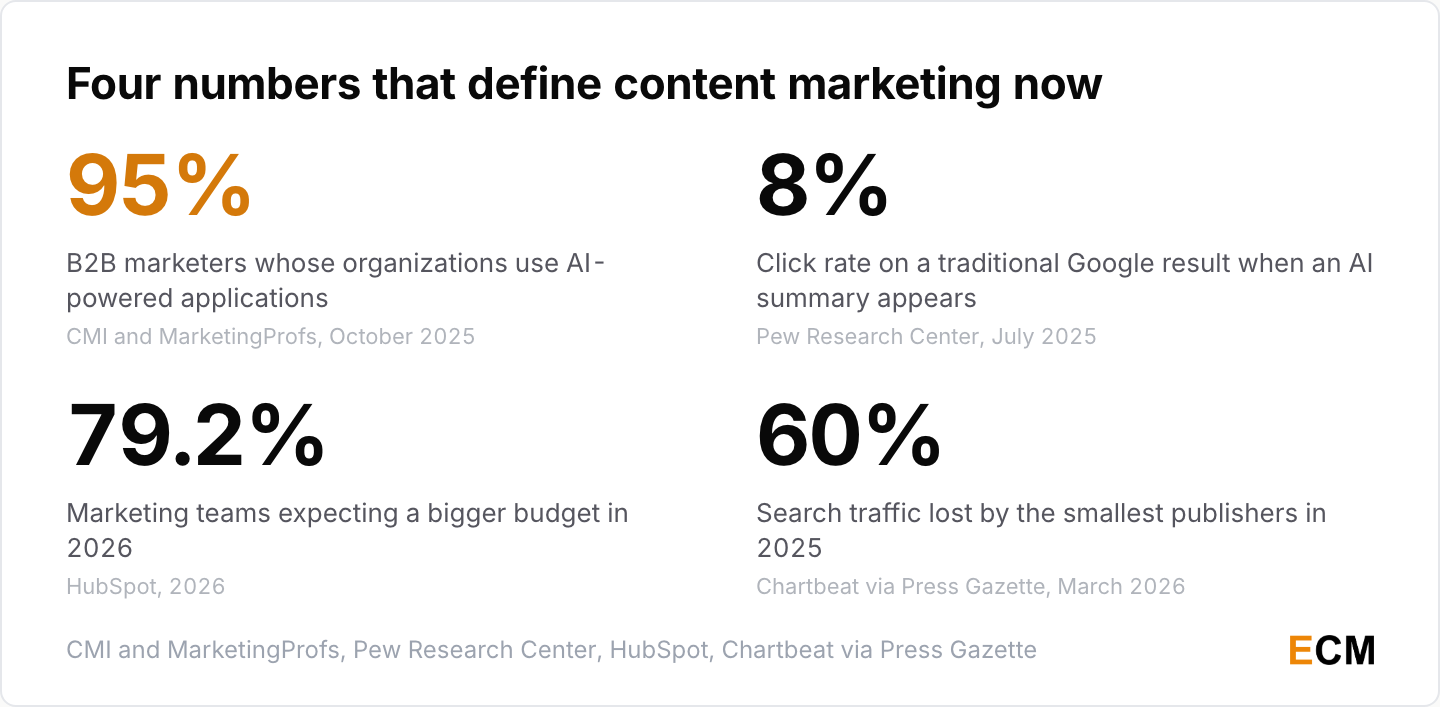
- AI is everywhere, integration isn’t. 95% of B2B marketers say their organizations use AI-powered applications, yet 48% still rate their AI maturity as only “developing” (CMI and MarketingProfs, October 2025).
- AI search is compressing clicks. Users click a traditional result on 8% of Google searches with an AI summary against 15% without one (Pew Research Center, July 2025).
- Small sites took the biggest hit. Publishers with 1,000 to 10,000 daily page views lost 60% of their search traffic in 2025 (Chartbeat data via Press Gazette, March 2026).
- Budgets are up, scrutiny is up with them. 79.2% of marketing teams expect a bigger 2026 budget, and 73% say that budget gets more scrutiny than before (HubSpot, 2026).
- B2B and B2C win on different channels. B2B marketers rank website, blog and SEO first for ROI at 30.2%, while B2C marketers rank paid social first at 28.5% (HubSpot, 2026).
- The market size is a range, not a number. Estimates run from USD 62.73B (Market Research Future, 2024) to USD 655.1B (Business Research Insights, 2026), so quote a range or don’t quote it.
Top Content Marketing Statistics for 2026
If you only take a handful of numbers into a planning meeting, take these.
Content Marketing Adoption, Then and Now
Adoption stopped being the question years ago. What changed is that almost every B2B team now runs a content strategy, and three in four have a dedicated team.
- 70% of companies were actively investing in content marketing in 2020, measured as active use, and a year later that share reached 82% (HubSpot, Not Another State of Marketing Report, 2021). On a different measure, CMI’s 2026 edition finds 97% of B2B marketers have a content strategy (CMI and MarketingProfs, October 2025).
- 76% of B2B companies have a dedicated content marketing team or person, and 54% of those teams are small, between two and five people (CMI and MarketingProfs, October 2024, 980 B2B marketers).
- 94% of marketers plan to use AI for content creation, blog articles included, in 2026 (HubSpot State of Marketing, 2026, 1,500+ marketers).
What Content Marketing Delivers for B2B Teams
Content earns awareness easily and revenue far less often, which is why awareness metrics dominate most reporting decks.
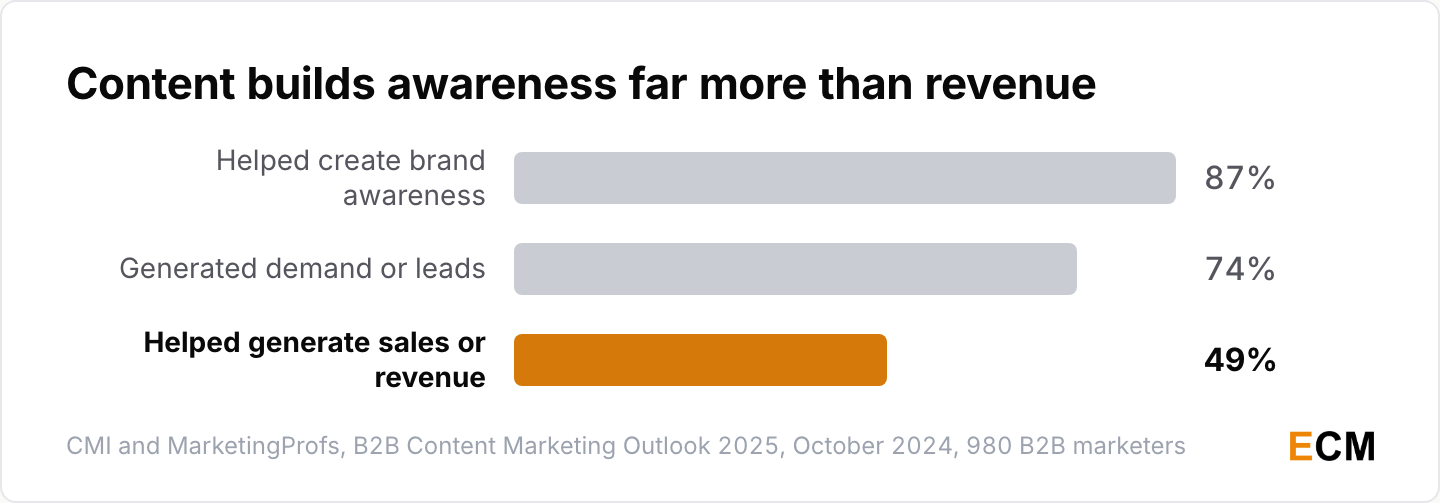
- 87% of B2B marketers say content helped create brand awareness in the last 12 months, 74% say it generated demand or leads, and 49% say it helped generate sales or revenue (CMI and MarketingProfs, October 2024).
- 58% of B2B marketers rated their content strategy only “moderately effective” (CMI and MarketingProfs, October 2024). A year later, 61% reported improved strategy effectiveness, but quality moved faster than results: 58% say content quality improved against 39% for content performance (CMI and MarketingProfs, October 2025).
- Only 26% of marketers think their organization has the right technology to manage content, down from 31% a year earlier (CMI and MarketingProfs, October 2024).
- 65% of marketing leaders believed brand is a critical driver of buyer behavior for existing customers, and 58% believed the same for prospects (Gartner Brand Survey, October 2019). That’s a 2019 number, so treat it as a benchmark, not a 2026 read.
AI in Content Marketing Statistics for 2026
Adoption is no longer the story; discipline is. Here’s what teams actually do with AI, and how thin the supervision still runs.
How Content Teams Use AI
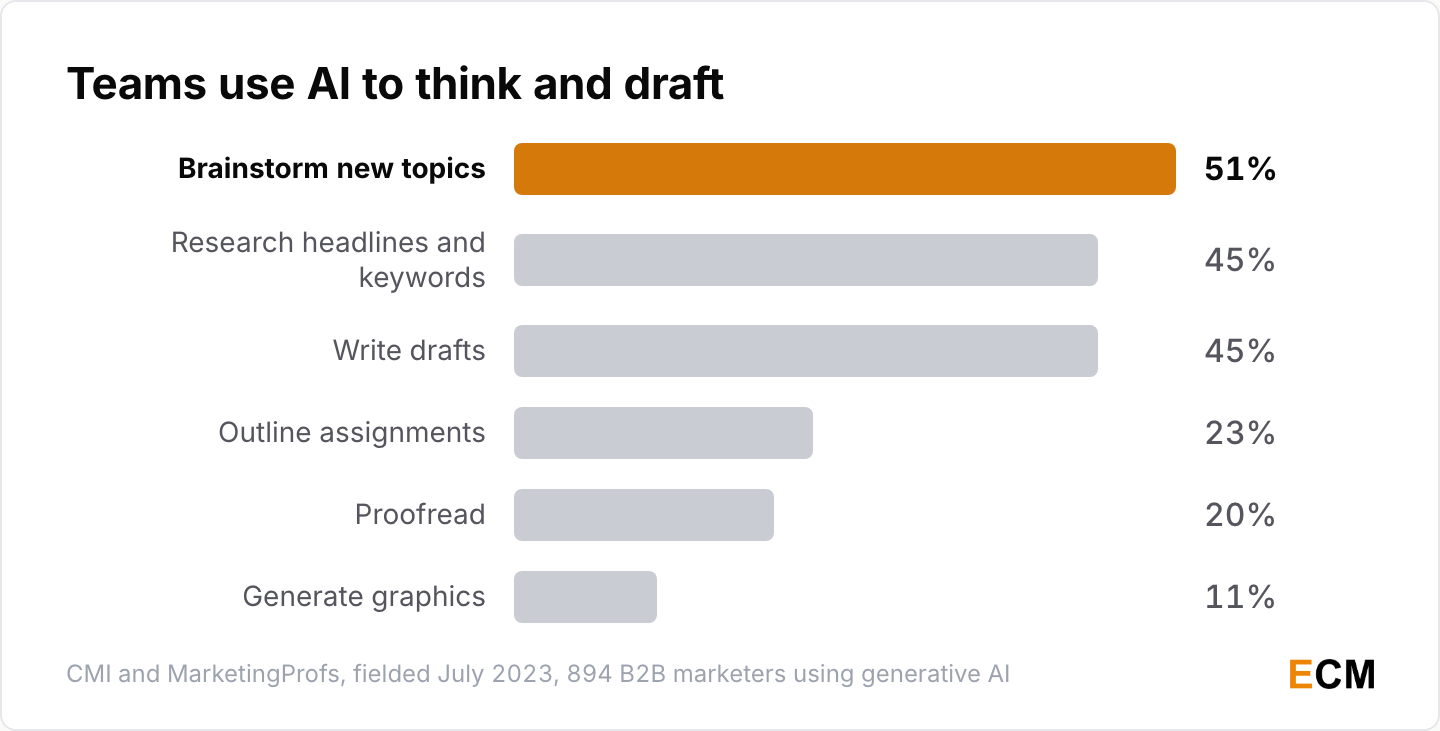
Most teams use AI tools as a thinking partner and a draft engine, not a publishing engine.
- AI use among B2B content teams went from 72% to 81% in one year (CMI and MarketingProfs, October 2024), and on CMI’s broader 2026 measure, 95% say their organizations use AI-powered applications (CMI and MarketingProfs, October 2025).
- The most common jobs for generative AI are brainstorming new topics (51%), researching headlines and keywords (45%) and writing drafts (45%) (CMI and MarketingProfs, fielded July 2023, 894 B2B marketers).
- Fewer teams use it to outline assignments (23%), proofread (20%) or generate graphics (11%), and only 5% each use it for audio content and video (CMI and MarketingProfs, fielded July 2023).
- 67% of businesses use AI for content marketing and SEO, and 78% of them are satisfied with the results (Semrush, January 2024, 2,600+ businesses).
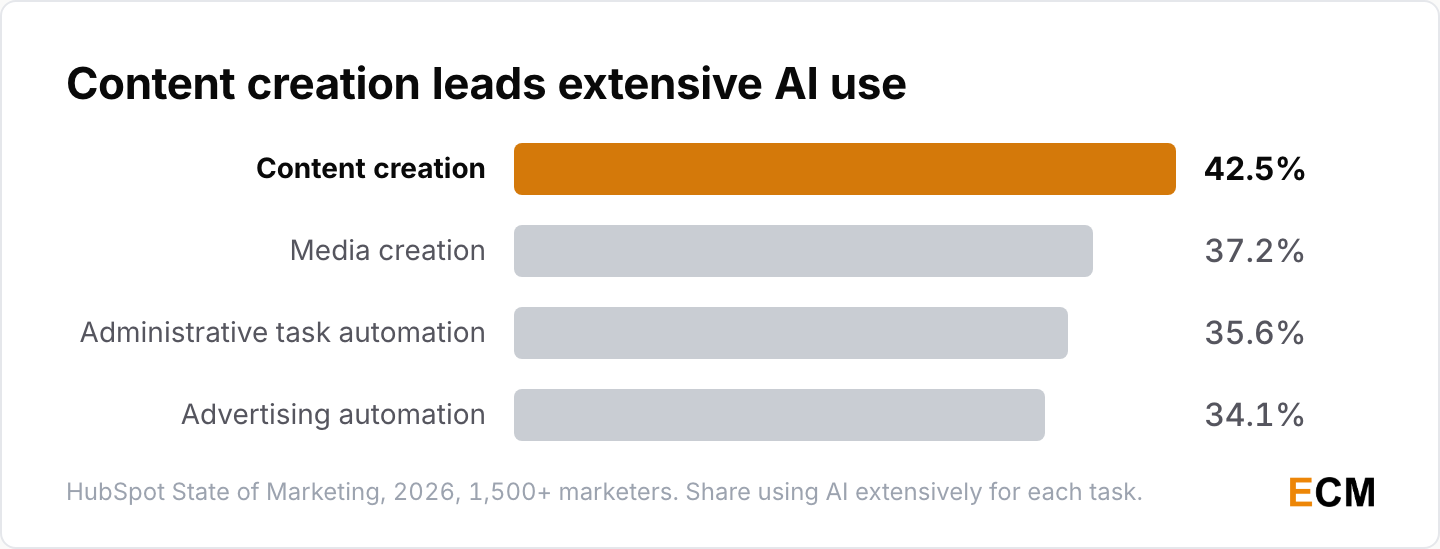
- The tasks marketers use AI for extensively are content creation (42.5%), media creation (37.2%), administrative automation (35.6%) and advertising automation (34.1%) (HubSpot, 2026, 1,500+ marketers).
AI Maturity, Guidelines and Training Gaps
Governance is catching up with adoption, but slowly, and the worry about jobs is growing faster than the skills gap is closing.
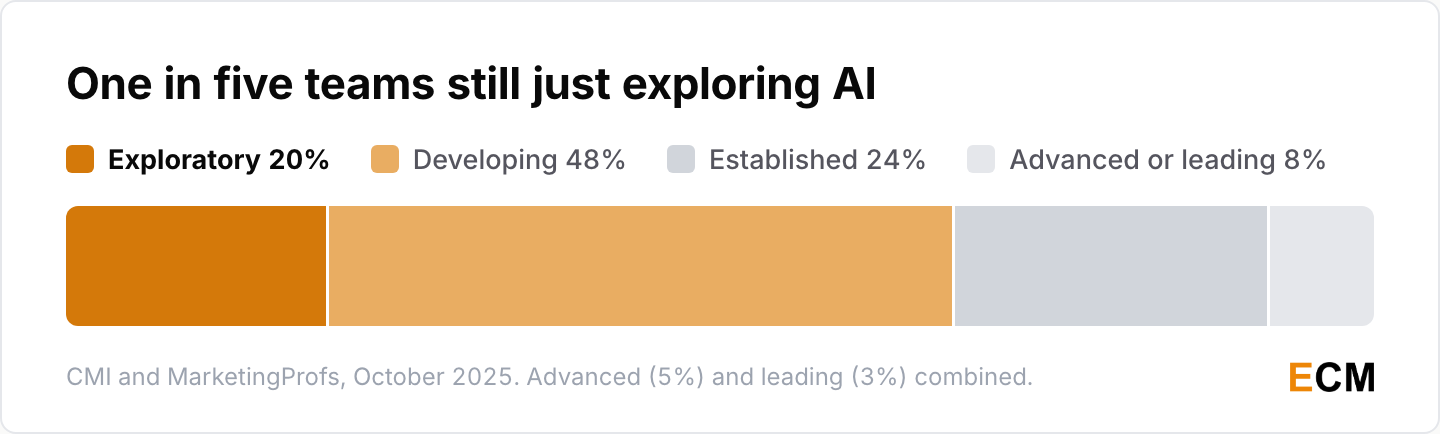
- B2B marketers rate their AI maturity as exploratory (20%), developing (48%), established (24%), advanced (5%) or leading (3%), so just 8% sit at the top two stages (CMI and MarketingProfs, October 2025).
- 45% of B2B organizations still have no written guidelines for generative AI use, down from 61% the year before (CMI and MarketingProfs, October 2024).
- 26% of marketing and business leaders were in the “Integration” stage of AI maturity in 2025 (Marketing AI Institute, May 2025, about 1,900 leaders). Counting Integration and Transformation together, the share rose from 43% in 2025 to 53% in 2026 (SmarterX, 2026 State of AI for Business, 2026, 2,100+ professionals).
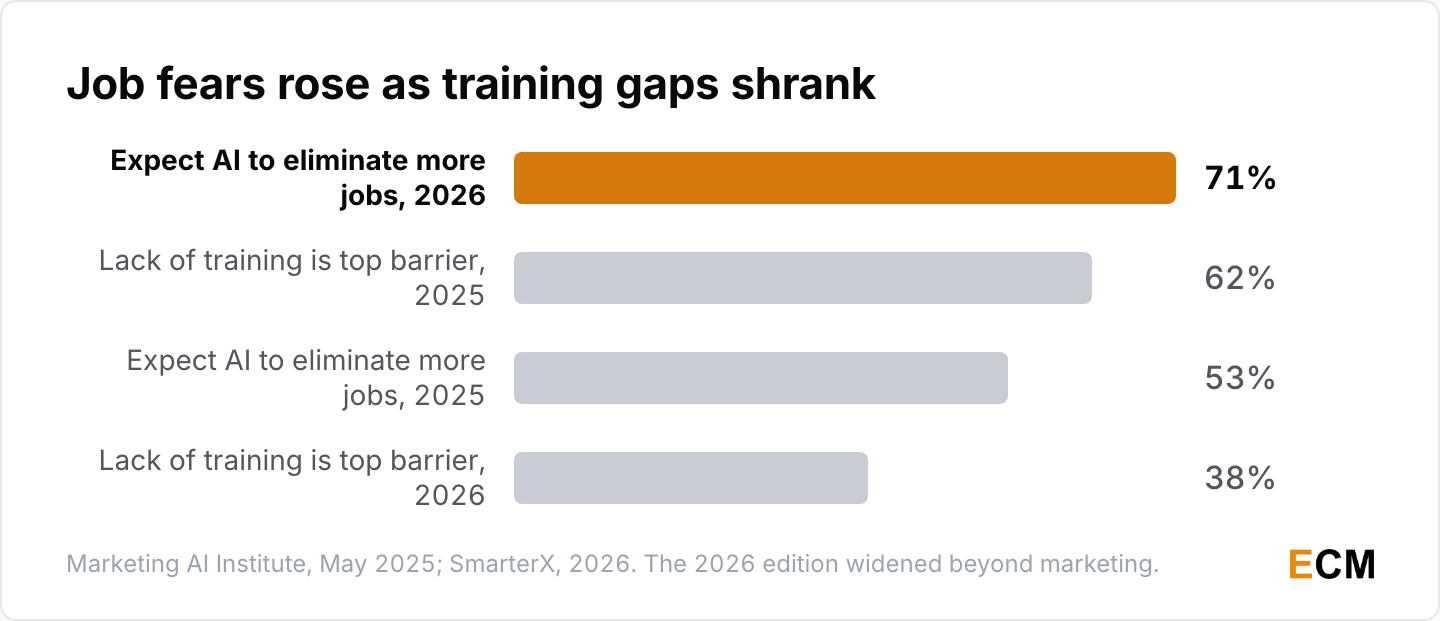
- In successive editions of the survey, which widened beyond marketing in 2026, the skills gap narrowed while job fears grew: lack of training was the top AI barrier for 62% of leaders in 2025 and 38% in 2026, and the share expecting AI to eliminate more jobs than it creates rose from 53% (Marketing AI Institute, May 2025) to 71%, against 13% expecting net job creation (SmarterX, 2026).
How Much Published Content Is AI-Generated
AI-generated content now accounts for about half of new web articles, but it shows up far less in top Google results.
- Primarily AI-generated articles reached 35.9% of articles published within 12 months of ChatGPT’s launch, passed human-written articles at 50.9% in Q4 2025, then slipped back to 49.9% in Q1 2026 (Graphite, May 2026).
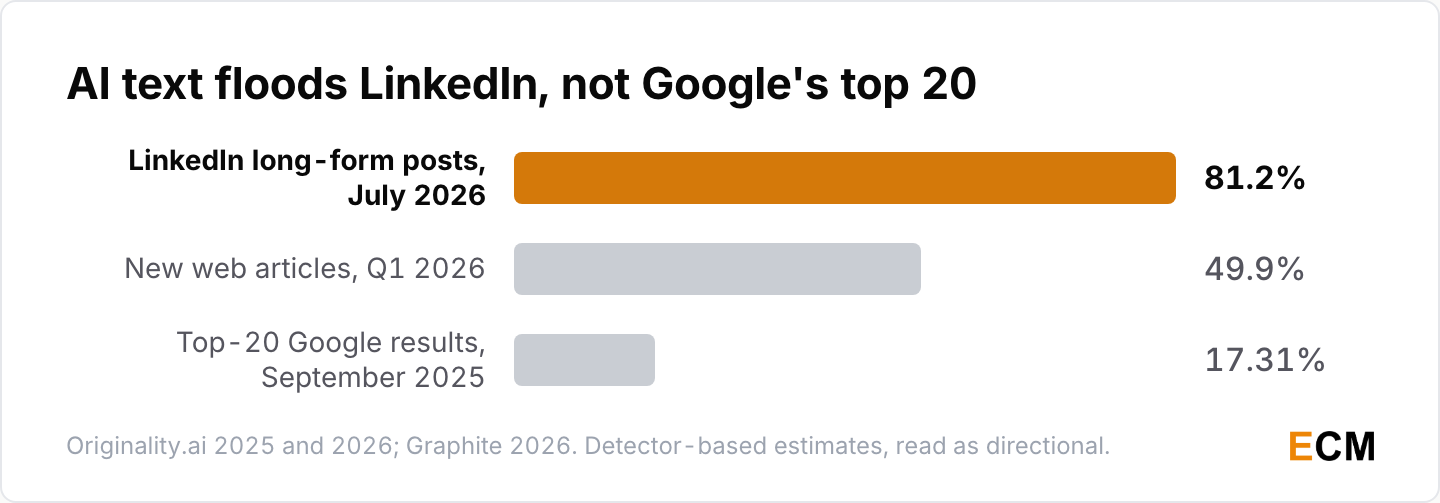
- 17.31% of top-20 Google results were classified as AI-generated as of September 2025, after a peak of 19.56% in July 2025 (Originality.ai, September 2025). Originality.ai sells AI detection software (I cover it in my Originality.ai review), so read it as directional.
- 81.2% of 5,000 public long-form LinkedIn posts were classified “Likely AI” in July 2026, up from roughly half in late 2024 (Originality.ai, July 2026). Style-edited human posts are exactly where detectors produce false positives, so the same caveat applies.
Content Marketing ROI Statistics by Channel and Format
What Is the Average ROI of Content Marketing?
There is no credible single ROI multiple for content marketing. The defensible numbers rank the top marketing channels by how many marketers call them their best performer.
- Across all marketers, website, blog and SEO is the #1 ROI-generating channel at 27%, with paid social second at 26% (HubSpot State of Marketing, 2026).
- Small businesses are 23% more likely than average to see ROI from blog posts (HubSpot State of Marketing, 2026).
- 70% of “very successful” and 68% of “successful” companies measure content ROI, against 46% of minimally successful and 56% of unsuccessful ones (Semrush, The State of Content Marketing 2023 Global Report, 1,700+ marketers in 34 countries).
Read that ranking against the AI search numbers further down and you get the real 2026 tension: the highest-ROI channel is the one AI Overviews squeeze hardest.
Which Content Formats Deliver the Best ROI
Video content wins every format ranking I can find, and blog posts still hold a top-five spot. I keep a separate set of video marketing statistics if you need the deeper cut on that format.
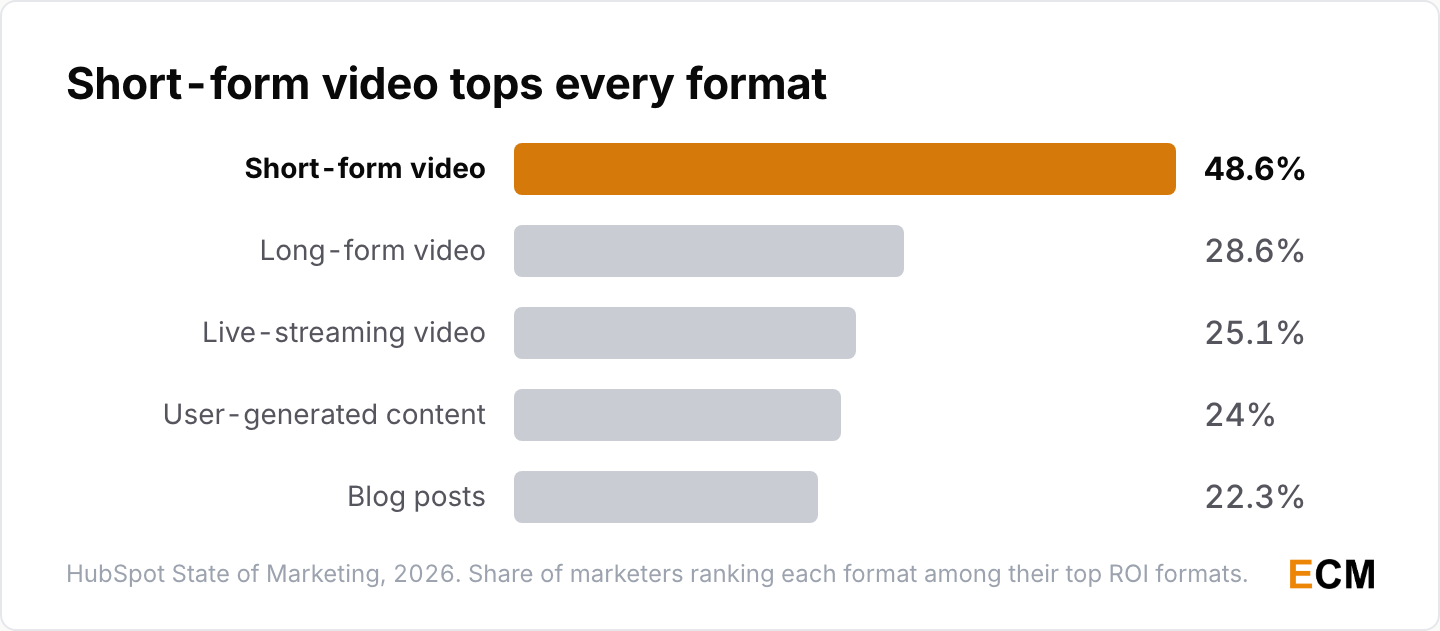
- Marketers rank short-form video (48.6%), long-form video (28.6%), live-streaming video (25.1%), user-generated content (24%) and blog posts (22.3%) as their top ROI formats (HubSpot, 2026).
- In Semrush’s global survey, video is the best-performing format at 45%, followed by short-form articles (31%), success stories (28%) and long-form blog posts (24%) (Semrush, 2023).
- Video captured 37.86% of 2024 content marketing revenue, and podcasts are projected to grow at a 15.52% CAGR through 2030 (Mordor Intelligence, 2025).
B2C Content Marketing Statistics vs B2B
Most content marketing statistics circulating in 2026 are B2B content marketing statistics wearing a general label; the CMI dataset everyone quotes surveys B2B marketers only. Separate the two audiences and the ROI ranking changes. My digital marketing statistics page rounds up the broader channel numbers.
Where B2B and B2C ROI Rankings Split
B2B teams earn their highest ROI from search and email; B2C teams earn theirs from social.
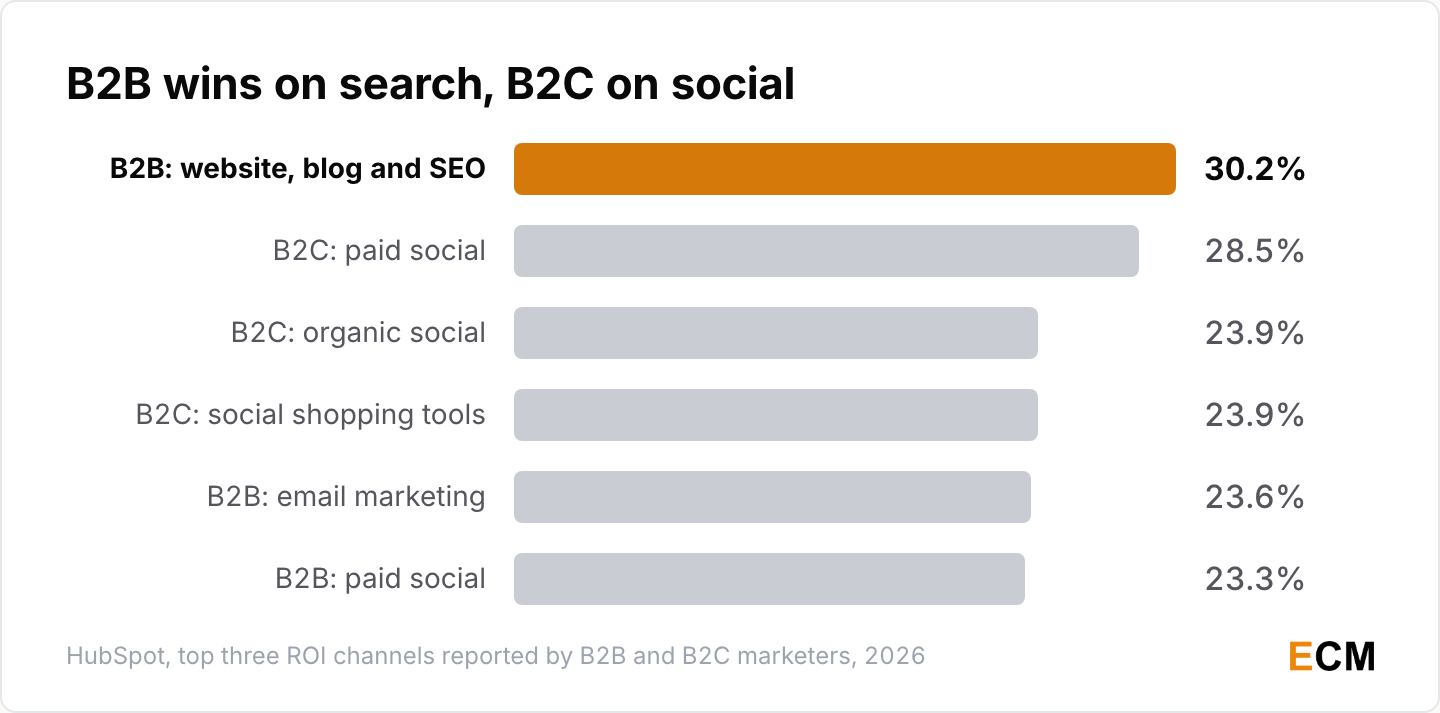
- B2B marketers name website, blog and SEO (30.2%), email marketing (23.6%) and paid social (23.3%) as their top ROI channels (HubSpot, 2026).
- B2C marketers name paid social (28.5%), organic social (23.9%) and social media shopping tools (23.9%) instead (HubSpot, 2026). Paid social is the only channel in both top threes.
- By usage, 48.4% of B2B marketers use website, blog and SEO, 39.3% email and 38.6% organic social, while B2C usage is nearly flat across organic social (41.7%), website, blog and SEO (41.6%) and paid social (41.2%) (HubSpot, 2026).
The practical read: if you’re B2C, social is doing the work B2B teams get from organic search, so the AI Overview click squeeze threatens you less. If you’re B2B, your best channel is the exposed one.
Social Traffic Share, Then and Now
Facebook still dominates social traffic, on two different measures taken seven years apart.
- Facebook drove 13.52% of total traffic for the business and marketing niche, and 65.36% of all social media traffic across niches, in Growth Badger’s traffic-source study (Growth Badger, 2019).
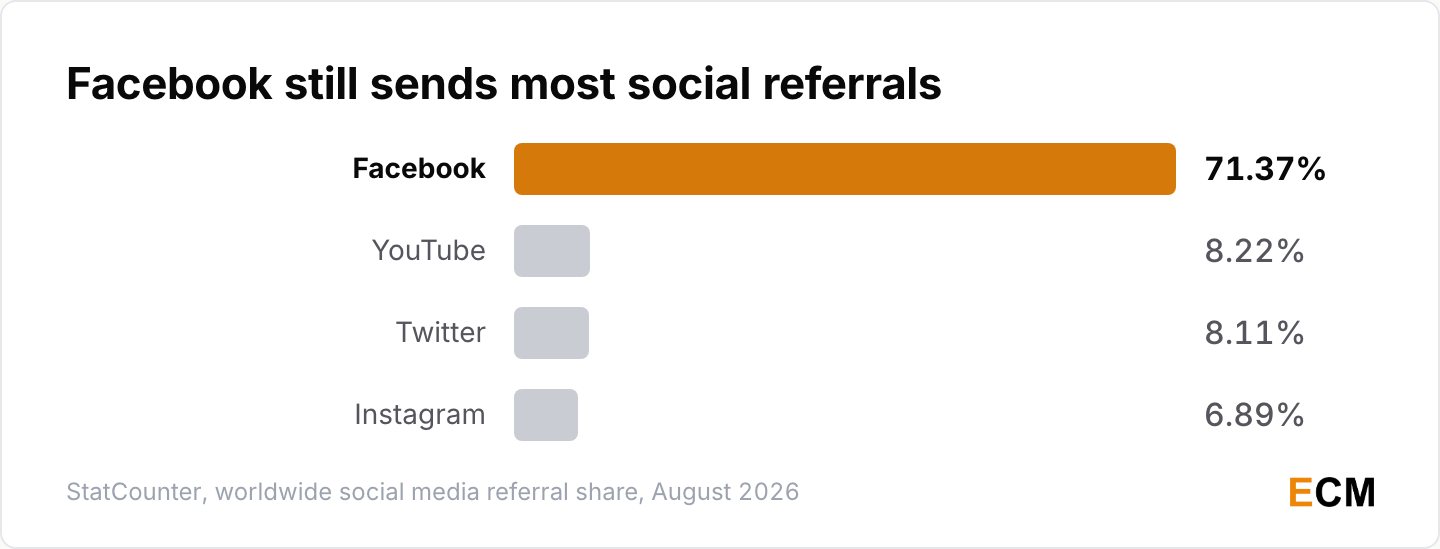
- Facebook now accounts for 71.37% of worldwide social media referrals, followed by YouTube (8.22%), Twitter (8.11%) and Instagram (6.89%) (StatCounter, August 2026).
Influencer Marketing Statistics
Influencer marketing is still a minority channel, and smaller creators beat celebrity accounts.
- Just 21.2% of brands use influencer marketing, 23.6% of B2C against 18.6% of B2B, and micro-influencers (32.4%) edge out macro-influencers (30.2%) as the most successful partners (HubSpot, 2026).
- US creator advertising spend reached an estimated $37bn in 2025 and is expected to grow four times faster than the ad industry as a whole (IAB estimate cited by the Reuters Institute, January 2026).
Content Marketing Budget Statistics for 2026
Budgets Are Rising Under More Scrutiny
Marketing budgets are growing, but marketing spend now comes with less benefit of the doubt attached to it.
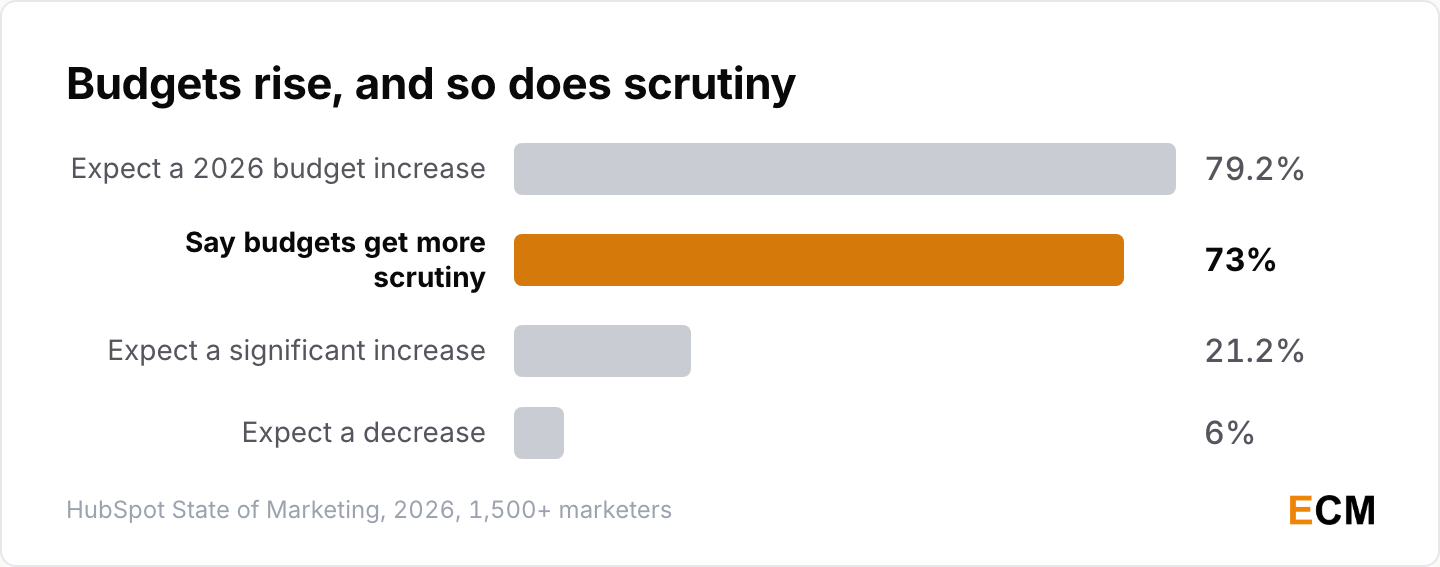
- 79.2% of marketing teams expect at least a slight budget increase in 2026, 21.2% expect a significant one and just 6% expect a decrease, yet 73% say their budget receives more scrutiny now than in the past (HubSpot, 2026).
Where the New Money Goes
The top 2026 investment areas are a near tie, which tells me most teams are hedging rather than betting.
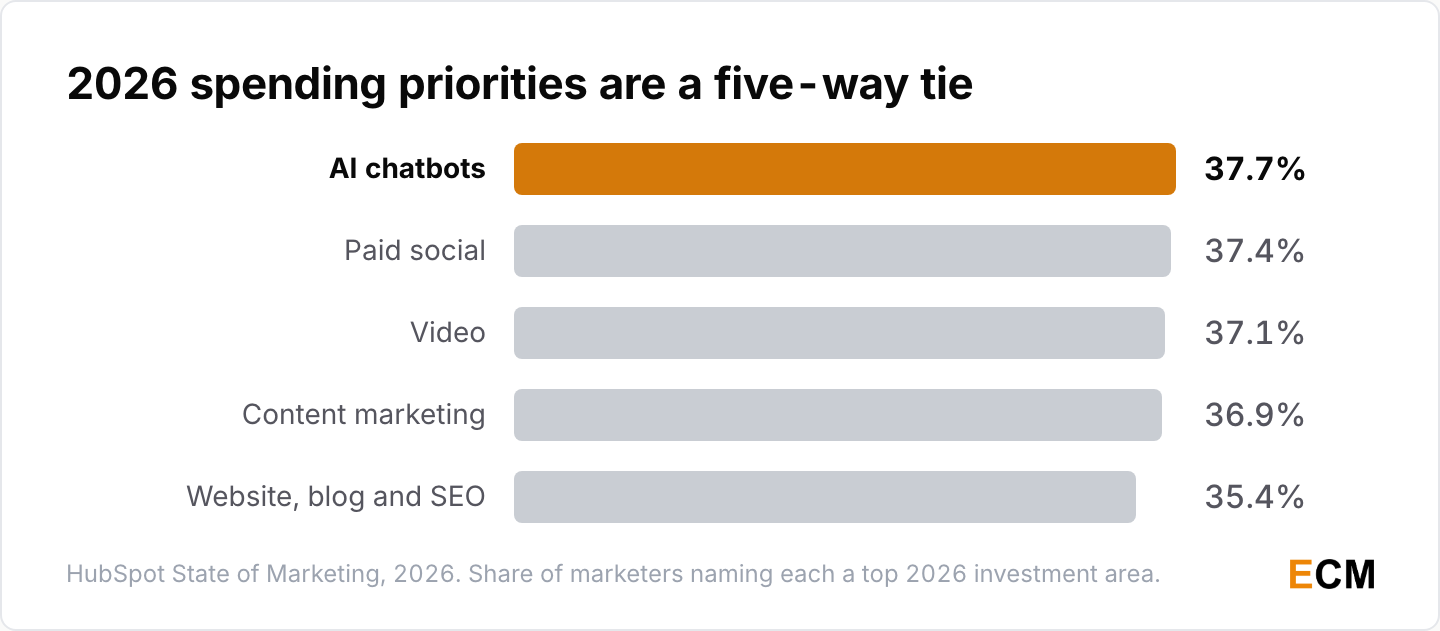
- The top five investment areas for 2026 are AI chatbots like ChatGPT, Perplexity, Gemini and Claude (37.7%), paid social (37.4%), video (37.1%), content marketing (36.9%) and website, blog and SEO (35.4%) (HubSpot, 2026).
- 45% of B2B marketers put AI-powered marketing tools at the top of their 2026 investment list, while human resources sit last at 9% (CMI and MarketingProfs, October 2025).
- 40.6% of marketers cite updating SEO for AI search changes as a top 2026 marketing trend (HubSpot, 2026), and 73.7% plan to maintain or increase their investment in voice search optimization (HubSpot State of Marketing, 2026).
Budget Share and ROI Measurement
Documented content marketing strategies, real budget commitment and actual measurement are the boring answer that keeps showing up.
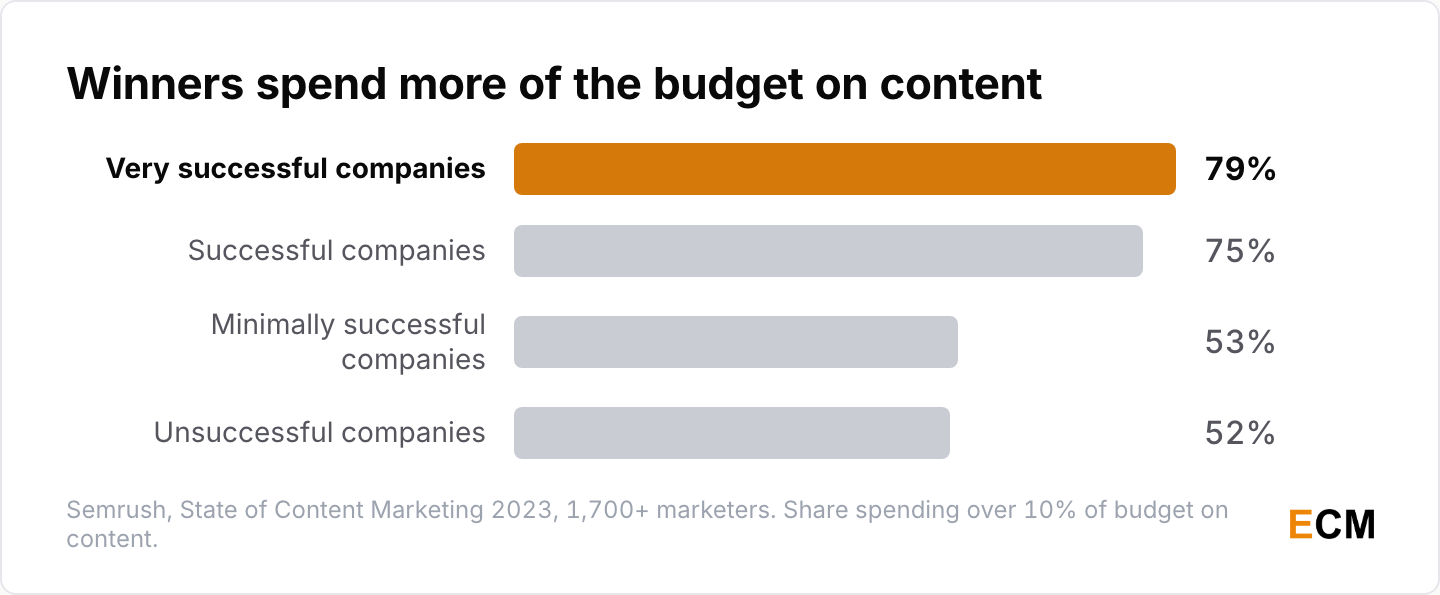
- 79% of “very successful” companies spend more than 10% of their marketing budget on content, against 75% of successful, 53% of minimally successful and 52% of unsuccessful companies (Semrush, 2023).
- 80% of very successful teams work from a documented content marketing strategy, against 52% of unsuccessful ones, and 49% of very successful teams use email marketing to promote what they publish (Semrush, 2023).
Semrush sells the tools (my Semrush review covers what they’re actually good at), so treat the numbers as directional, not gospel. The pattern still holds.
Content Marketing Market Size Estimates
The “$600B global content marketing market” is not one number. Three research firms size the market three different ways, because each defines it differently.
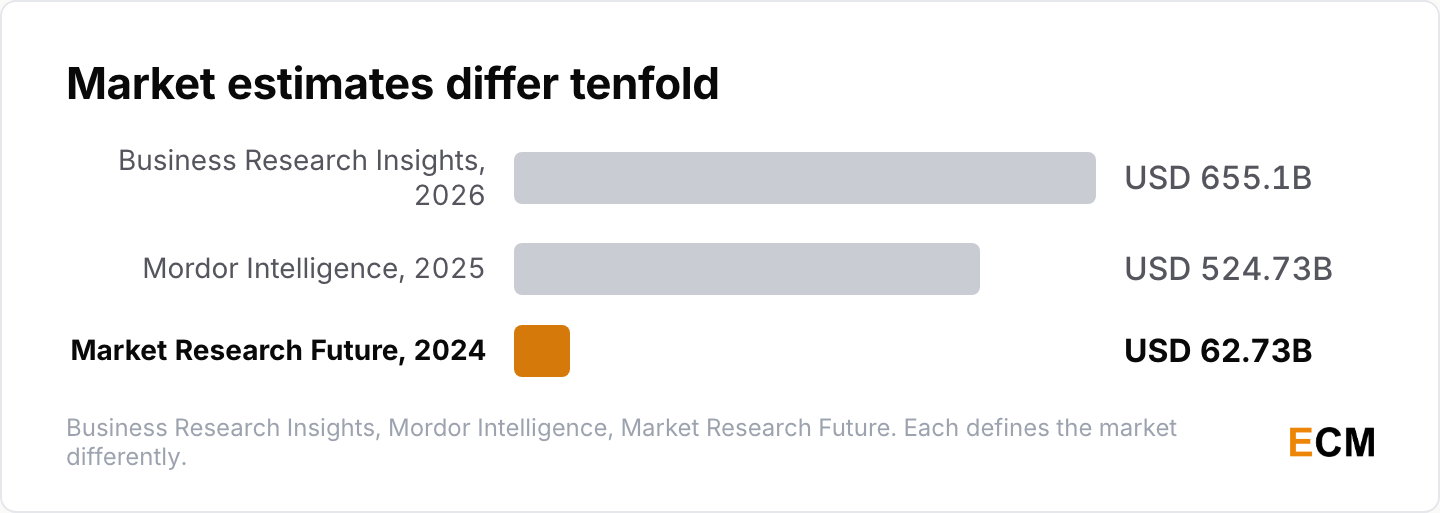
- Mordor Intelligence puts the 2025 content marketing market at USD 524.73B, rising to USD 989.84B by 2030 at a 13.53% CAGR, with North America generating 40.83% of 2024 revenue (Mordor Intelligence, 2025).
- Business Research Insights pegs 2026 at USD 655.1B, rising to USD 2,100.28B by 2035 at a 13.82% CAGR (Business Research Insights, 2026).
- Market Research Future estimates the 2024 market at USD 62.73B, a tenfold gap from the other two (Market Research Future, 2024).
AI Search and Content Discovery Statistics
The most rigorous public dataset on AI Overviews is Pew’s, built on real browsing data rather than keyword panels. For content marketing SEO statistics beyond AI Overviews, I keep a separate SEO statistics page.
How AI Overviews Change Click Behavior
Searches with AI summaries get roughly half the clicks on traditional results, and almost nobody clicks the links inside them.
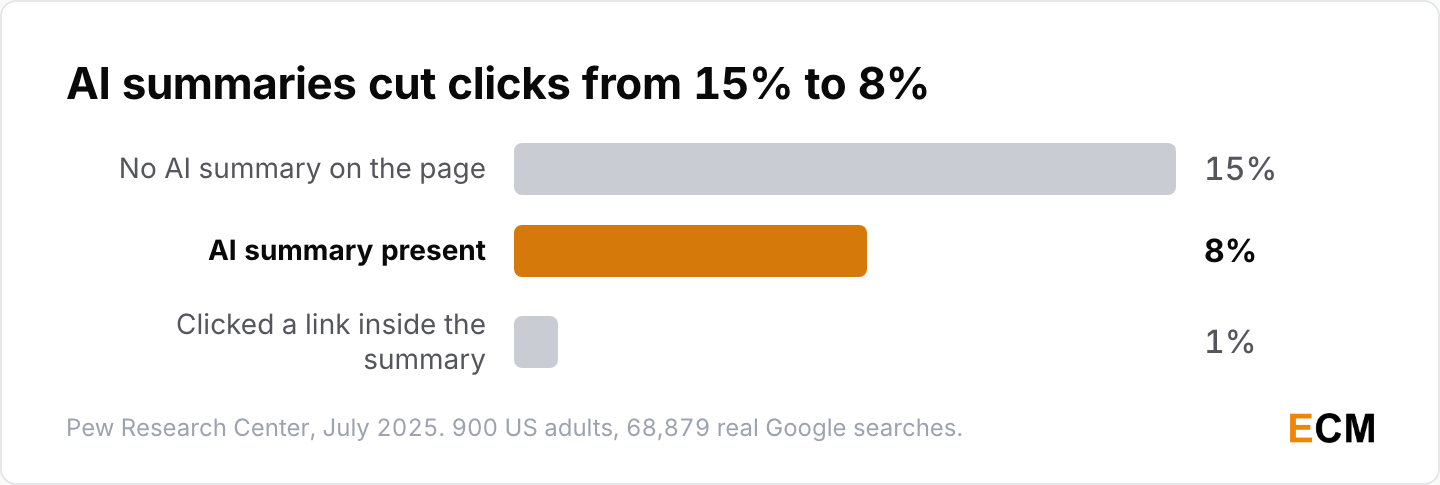
- On Google searches with an AI summary, users clicked a traditional result 8% of the time, against 15% without one, clicked a link inside the summary on just 1% of visits, and ended the session on 26% of them against 16% without a summary (Pew Research Center, July 2025, 900 US adults, 68,879 searches).
- 18% of Google searches in March 2025 produced an AI summary, 58% of users saw at least one that month, and 60% of question-word queries triggered one against 8% of one- or two-word queries (Pew Research Center, July 2025).
- 20% of US adults find AI summaries extremely or very useful, 52% somewhat useful and 28% not too or not at all useful (Pew Research Center, October 2025, 5,153 US adults).
- An AI Overview now correlates with a 58% lower click-through rate for the top-ranking page, up from 34.5% in Ahrefs’ earlier study (Ahrefs, February 2026, 300,000 keywords).
- Organic CTR on queries with an AI Overview bottomed at 1.3% in December 2025 and recovered to 2.4% by February 2026 (Seer Interactive, 2026, 53 brands, 5.47M queries). That recovery is the one hopeful number in this section.
How Often AI Overviews Appear
Google tested AI Overviews hard in 2025, then pulled back, and moved them toward commercial queries along the way.
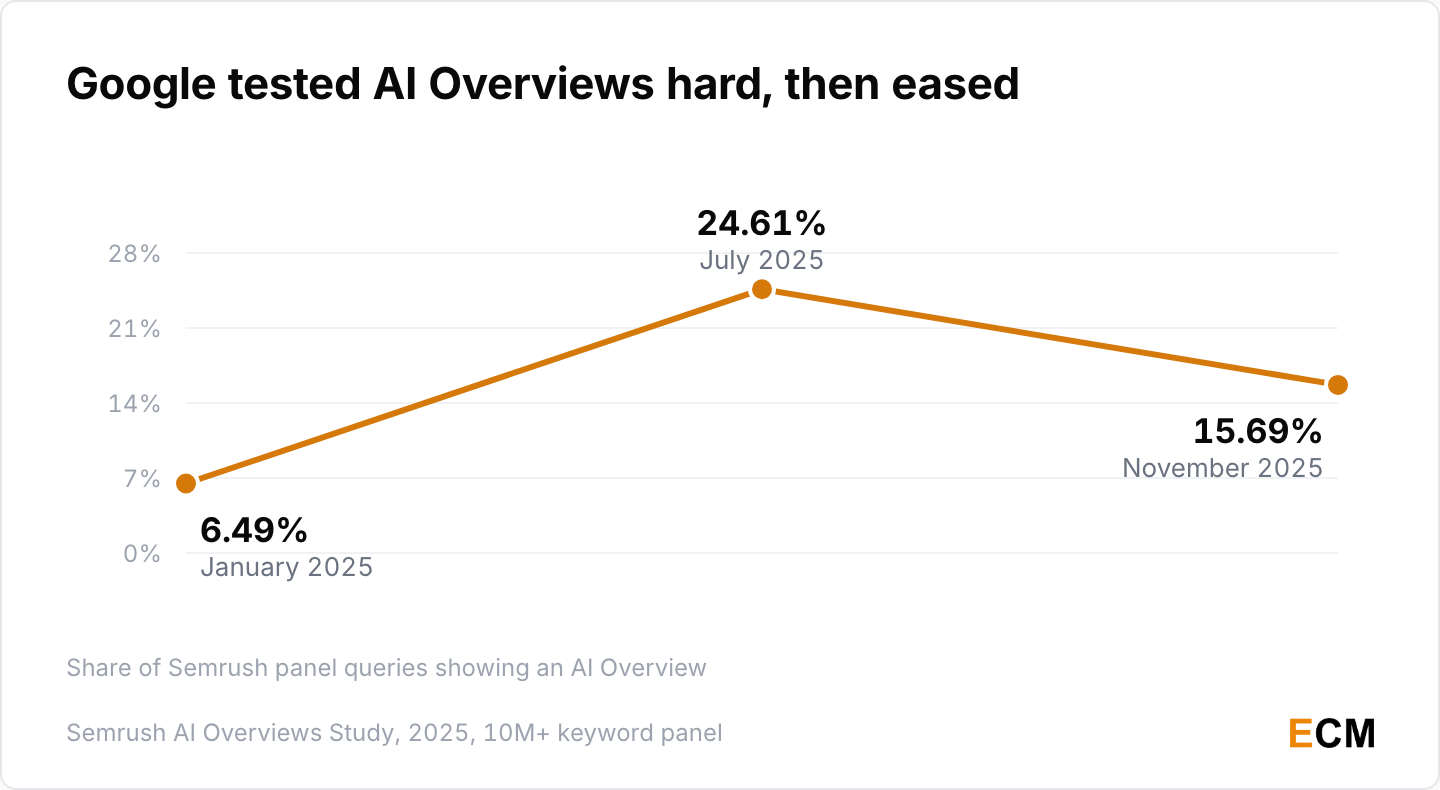
- AI Overviews appeared for 6.49% of queries in January 2025, peaked at 24.61% in July and settled at 15.69% in November (Semrush, 2025, 10M+ keywords).
- 91.3% of AI Overview queries were informational in January 2025; by October only 57.1% were, and ads appeared on 25% of AI Overview results pages, up from under 1% in March (Semrush, 2025).
If you want to see whether your own keywords trigger AI Overviews, my AI Overview checker pulls the live SERP for any query.
Publisher Search Traffic by Site Size
The aggregate traffic number hides everything that matters here: small sites absorbed roughly three times the damage large ones did.
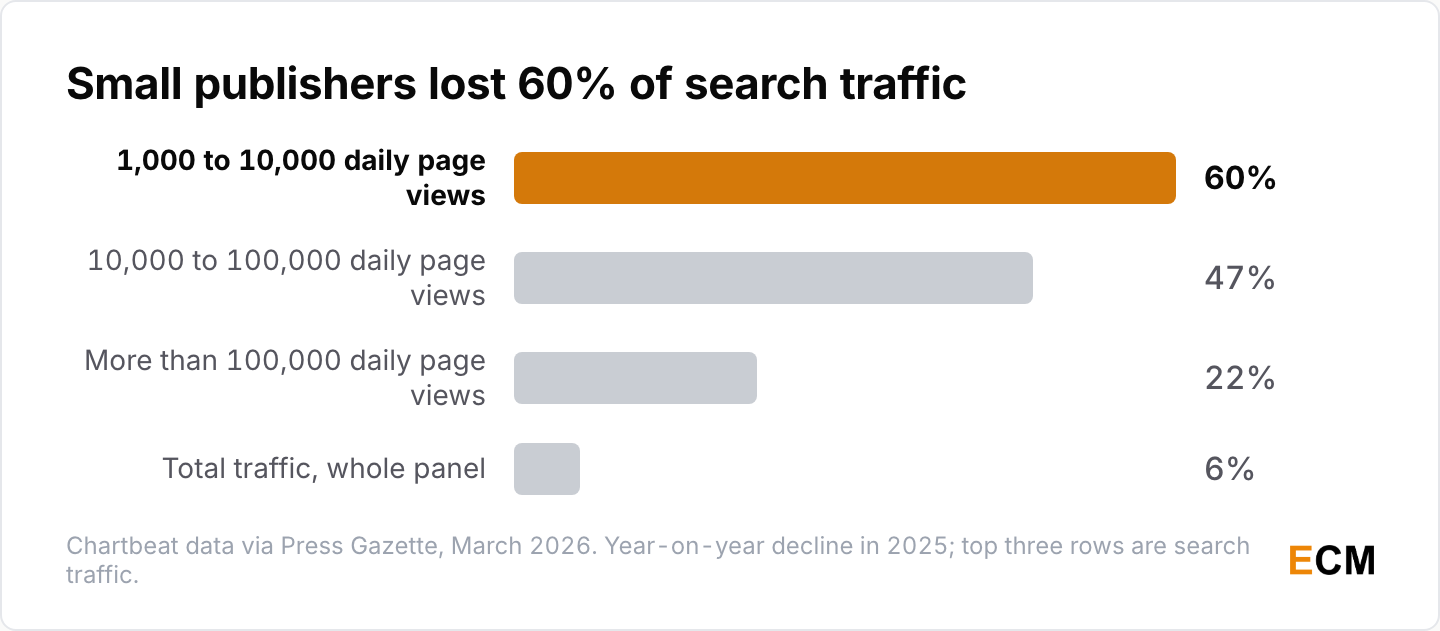
- Search traffic fell 60% in 2025 for sites with 1,000 to 10,000 daily page views, 47% for sites with 10,000 to 100,000, and 22% for sites above 100,000, while total traffic across the panel fell only 6% (Chartbeat data via Press Gazette, March 2026).
- Google organic search traffic to more than 2,500 sites fell 33% globally and 38% in the US between November 2024 and November 2025 (Reuters Institute, January 2026). The report adds that it isn’t clear how much of that is down to AI Overviews.
- Google Discover referrals to the same 2,500-site Chartbeat panel fell 21% year on year (Press Gazette, January 2026).
AI Crawlers and AI Referral Traffic
Most AI crawling is extraction, not distribution, and that asymmetry is the real story behind every “should I block AI crawlers” debate.
- AI “user action” crawling, bots fetching pages for a live prompt, increased more than 15x in 2025 (Cloudflare Radar, December 2025), and training grew from 72% of AI crawling in July 2024 to 79% in July 2025 (Cloudflare, 2025).
- Anthropic’s crawler made about 70,900 page requests for every referral it sent back in the week of June 19 to 26, 2025, while Mistral’s ratio was 0.1:1 (Cloudflare, 2025).
- ChatGPT referrals to news sites ran just under 1 million from January to May 2024 and passed 25 million in 2025 (Similarweb data via TechCrunch, July 2025), yet AI referrals make up just 1.08% of website traffic across 10 major industries, with ChatGPT sending 87.4% of it (Conductor, 2026 AEO/GEO Benchmarks Report, data from May to September 2025).
- 7% of people use an AI chatbot for news each week, rising to 15% of under-25s (Reuters Institute Digital News Report, June 2025, 48 markets).
- Across six countries, people who have ever used generative AI rose from 40% to 61% between 2024 and 2025, and weekly use nearly doubled from 18% to 34% (Reuters Institute, Generative AI and News Report, October 2025).
Frequently Asked Questions
What are the latest content marketing statistics for 2026?
The freshest primary numbers come from CMI’s 2026 B2B edition (CMI and MarketingProfs, October 2025), where 95% use AI-powered applications and 97% have a content strategy, and HubSpot’s 2026 report (HubSpot, 2026), where 79.2% expect a bigger budget.
What is the average ROI of content marketing?
No primary study publishes a credible average ROI multiple. HubSpot ranks website, blog and SEO as the top ROI channel across all marketers at 27% (HubSpot, 2026), and only 49% of B2B marketers credit content with sales or revenue (CMI and MarketingProfs, October 2024).
What percentage of content marketers use AI in 2026?
95% of B2B marketers say their organizations use AI-powered applications (CMI and MarketingProfs, October 2025), and 94% of marketers plan to use AI for content creation (HubSpot, 2026). Committed integration is lower: 48% still rate their AI maturity as developing (CMI and MarketingProfs, October 2025).
How do B2C content marketing statistics differ from B2B?
B2B marketers rank website, blog and SEO first for ROI at 30.2%, while B2C marketers rank paid social first at 28.5% (HubSpot, 2026). Paid social is the only channel in both top threes, so a B2C team copying B2B benchmarks may over-invest in organic search.
How much of Google search now triggers AI Overviews?
18% of real Google searches produced an AI summary in March 2025 (Pew Research Center, July 2025). Semrush tracked prevalence rising from 6.49% to a 24.61% peak in July 2025, then easing to 15.69% by November (Semrush, 2025).
Has AI hurt publisher traffic from search?
Search traffic fell sharply, especially for small publishers. Sites with 1,000 to 10,000 daily page views lost 60% of search traffic in 2025, against 22% for sites above 100,000 (Chartbeat data via Press Gazette, March 2026). How much of that is down to AI Overviews is unclear; algorithm updates and audience behavior moved in the same period.
How big is the content marketing market?
Estimates range from USD 62.73B for 2024 (Market Research Future, 2024) to USD 524.73B for 2025 (Mordor Intelligence, 2025) and USD 655.1B for 2026 (Business Research Insights, 2026). Each firm defines the market differently, so use a range.
Written by
Editorial Staff
The Editorial Staff represents the writers, editors, and content creators who have worked (or work) at Elite Content Marketer. The experimenter-in-chief behind the team is Chintan Zalani, who has close to a decade of experience trying to make sense of the content marketing industry. Started in 2019, Elite Content Marketer is on a mission to help creators build sustainable businesses.
Related Articles
Marketing Data
Affiliate Marketing Statistics 2026: 60 Facts + $13.6B Spend
60 affiliate marketing statistics: $13.62B in US spend in 2024, 9.4% of US e-commerce sales, a 15X UK return and what affiliates really earn.
Oct 23, 2026Read more →
Marketing Data
Black Friday Statistics 2026: 57 Facts + $11.8B in Sales
57 Black Friday statistics: $11.8B in US online sales in 2025, 202.9M US weekend shoppers, and 84% of shoppers suspect inflated pre-sale prices.
Oct 22, 2026Read more →

Marketing Data
58 AI Personalization Statistics for 2026: ROI + Adoption
58 AI personalization statistics for 2026: 78% of marketers can’t make enough personalized content, and 87% of brands rate it good while 29% of consumers agree.
Oct 2, 2026Read more →