
EliteContentMarketer
AI Tools & Software

Best AI Music Generators 2026

Ayushi KhandelwalWritten by Ayushi Khandelwal··9 min read
Best AI Music Generators 2026
The royalty-free music sites I recommended here in 2021 still exist, but they’re not what I reach for anymore. In 2026, when I need a 30-second intro jingle or a moody background bed for a podcast episode, I type a description into an AI music generator and have three variations inside a minute. No license search. No “does this match my episode tone?” scrolling. Just prompt, listen, tweak. That shift matters for podcasters and content marketers specifically. You’re no longer picking from someone else’s catalog. You’re describing the vibe you want and getting a track made for it. The tradeoff: output quality varies wildly by tool, commercial licensing rules are still a mess, and “AI-generated” carries different weight with different audiences. Below are the 10 AI music generators I’ve tested or evaluated for podcast intros, background beds, and video soundtracks in 2026 — with specific callouts on where each one breaks down.

Suno: Best Overall for Vocal Tracks and Full Songs

Suno AI music generator screenshot
Suno is the tool most creators land on first, and for reasons worth understanding. Based on testing and the pricing published on suno.com, you can turn a one-line prompt like “90-second upbeat intro jingle for a B2B marketing podcast, light piano and synth, female vocal hook” into a full track with lyrics and vocals. V4 outputs tracks up to four minutes. The Suno Studio feature, rolled out to Premier subscribers in early 2026, is the first AI-native digital audio workstation — timeline editing, MIDI export, and stem generation that layers on top of audio you already have. That’s a real shift. You’re no longer generating a song and hoping it fits; you’re treating generations as editable building blocks. Pricing: Free plan for non-commercial experimentation. Pro at $10/user/month covers commercial rights and higher volumes. Premier at $30/user/month adds Suno Studio and 12-stem splits. Enterprise is a custom quote. The weak spot: lyrics quality. Suno’s generated lyrics often fall into a generic pop mush that doesn’t match specific brands or niches. If you need lyrics with any specificity, write them yourself and feed them in. The generator handles instrumentation better than it handles language.

Udio: Best for Genre Fidelity and Musical Taste

Udio AI music generator screenshot
Udio came out of ex-Google DeepMind researchers, and it shows in the output. Where Suno sometimes produces tracks that sound like “AI music,” Udio frequently produces tracks that sound like actual genre pieces — a convincing 90s grunge demo, a tight lo-fi beat, a passable trap loop. Based on pricing published on udio.com, commercial rights come with paid plans and require no attribution. Plans: Free tier gives 10 credits a day plus 100 bonus monthly credits. Standard at $10/month gets you 1,200 credits — roughly 600 full songs at 2 credits each. Pro at $30/month gets 4,800 credits and bulk download. The stem download feature is the reason Udio ends up in production workflows. You can pull bass, drums, and vocals separately and remix them with your own instrumentation. For a podcaster mixing an intro against a host’s voice, being able to lower the vocal stem by itself is the difference between usable and unusable. What breaks: Udio’s free tier full-song cap and the inability to download high-quality audio files without paying. You can preview everything but you can’t actually use the free outputs in a published piece.

ElevenLabs Music: Best Free Option for Quick Jingles
ElevenLabs Music AI screenshot
ElevenLabs launched a dedicated music product in April 2026, sitting alongside their voice and sound-effects tools. Based on the TechCrunch launch coverage and pricing on elevenlabs.io, ElevenLabs Music is currently free to use, with a cap of around seven songs per day via natural language prompts. For content marketers already using ElevenLabs for voiceover, having music generation inside the same account is the real pitch. You generate a narration track and a background bed without leaving the tool. For podcasters using ElevenLabs for voice cloning or dubbing, music is a drop-in addition. The limitation: ElevenLabs Music is newer than Suno and Udio and the outputs feel it — instrumentation is competent but the arrangements are less developed. It’s a solid option for a 15-second intro jingle, less obviously good for a three-minute episode theme.

Soundraw: Best for Background Beds with Customization
Soundraw AI music generator screenshot
Soundraw positions itself for creators who want control without needing to prompt from scratch. You pick a mood, genre, length, and instruments, and the platform generates tracks you can then customize — shorten, rearrange sections, change the energy of a specific bar. Based on Soundraw’s site, pricing starts at around $11.04/month on the Creator plan and goes up to $64.99/month for the top tier. The tool pitches itself to YouTubers and podcasters specifically. The customization interface is where it earns its keep: you’re not accepting the first output, you’re sculpting it. See the full Soundraw review for more detail on what the customization interface can and can’t do. Where Soundraw is weaker: no vocal generation. If you need a sung hook, you need Suno or Udio. Soundraw is background-bed territory, and it’s excellent there — but it’s not a one-tool solution if your podcast opens with a vocal tag.

AIVA: Best for Cinematic and Orchestral Composition
AIVA AI music composer screenshot
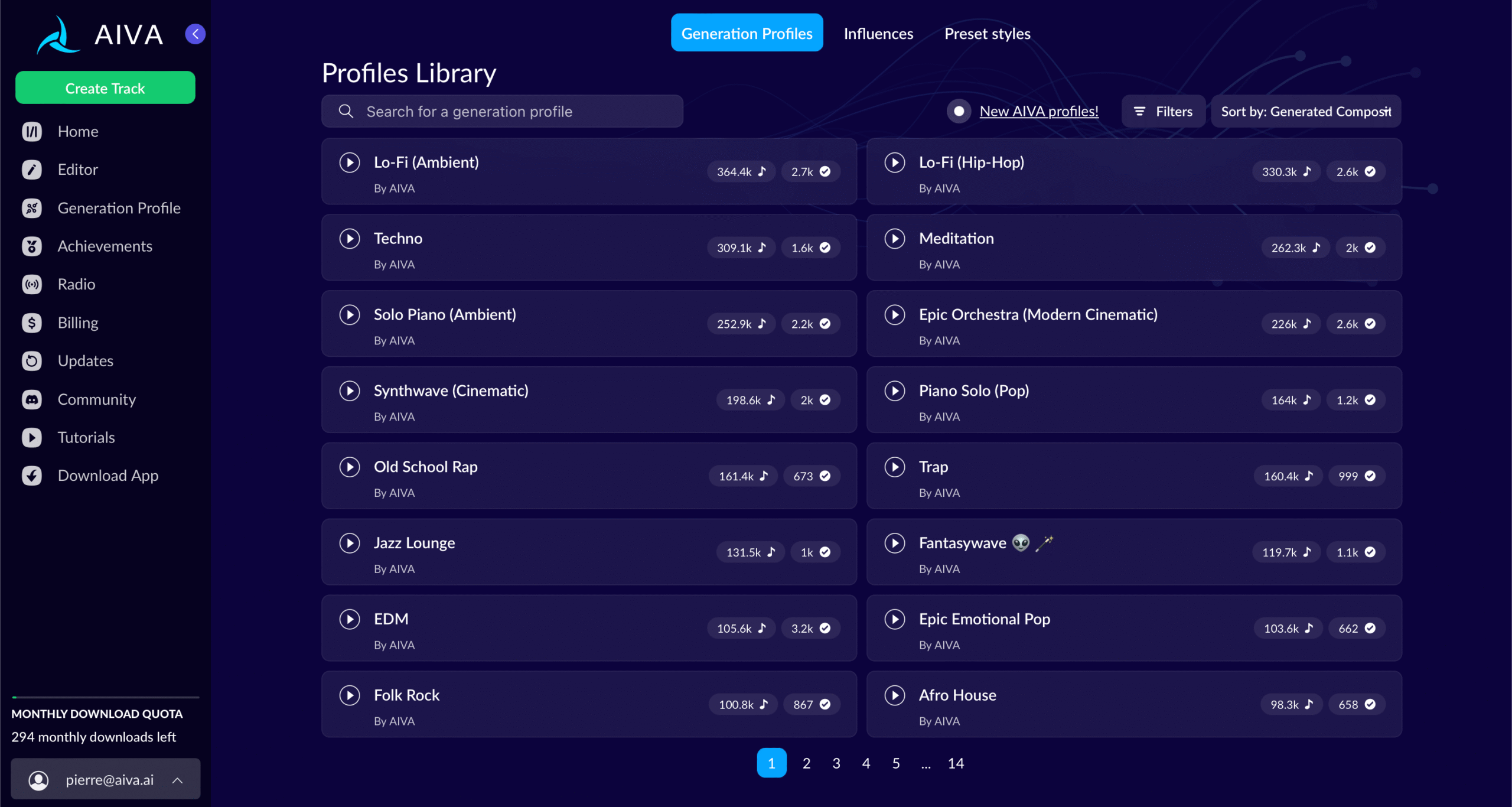
AIVA is the oldest AI composer on this list, with a focus on classical, orchestral, and cinematic output. Based on AIVA’s site, the Standard plan is $15/month and the Pro plan is $49/month — the Pro plan is the one that matters, because it’s the only tier where the music is copyrighted to you and fully monetizable. For a drama podcast, true-crime series, or any show where the musical bed needs to feel composed rather than generated, AIVA still pulls its weight. It reads more like a film scoring tool than a jingle generator. The friction: AIVA’s interface is dated compared to Suno or Udio, and the generation times are longer. You’re trading ease for output sophistication in a specific genre.

Mubert: Best for Streaming and Long-Form Background

Mubert generative music screenshot
Mubert’s pitch is generative streams — you set parameters and get continuous, non-repeating music for as long as you need it. That’s a different use case than single-track generation. For live streams, Twitch overlays, long background beds for video content, or in-store music, Mubert’s model fits. Based on Mubert’s site, the free plan includes 25 tracks/month. Paid tiers include Creator at $14/month, Pro at $39/month, and Business at $199/month. The honest problem with Mubert: for short-form use (podcast intro, 60-second Instagram Reel), the generative-stream model is overkill. You end up exporting a clip from a stream, which is less direct than just prompting for a 60-second track in Suno.

Beatoven.ai: Best Budget Option with Commercial Rights

Beatoven focuses on mood-based instrumental generation for videos and podcasts. You pick a mood, a genre, a length, and Beatoven builds a track. The commercial rights on paid plans are the selling point — this is one of the few cheap options where you can publish the output to a monetized YouTube channel without fine print. Based on Beatoven’s site, plans start at around $2.50/month with commercial rights — the cheapest paid option on this list. Creator is $14/month, Pro is $39/month, Business is $199/month. You can also buy minutes separately at $3 per minute for one-off projects. The catch: Beatoven’s output quality is below Suno and Udio. You’re getting a functional background bed, not a track you’d release on Spotify. For a podcast intro bed where the music supports a voiceover rather than standing on its own, that’s fine. For anything foreground, look elsewhere.

Boomy: Best for Instant Listen-able Tracks

Boomy is positioned for people who want to make music but don’t want to think about prompting. You pick a style, hit generate, and get a track. It’s the closest thing to “one-click music” on the list, which has upsides and downsides. Based on Boomy’s site, the free tier lets you make tracks but caps what you can download or monetize. Paid plans start around $2.99/month — the cheapest entry point in this category. Boomy is genuinely useful for creators who need a placeholder track fast and don’t care about granular control. It’s less useful if you have a specific sound in mind, because prompt control is thin. I’d put it in “draft audio” territory rather than “final audio.”

Stable Audio: Best for Sound Effects and Instrumental Clips

Stable Audio (from Stability AI) generates instrumental audio and sound effects from text prompts. It doesn’t do vocals and doesn’t pretend to. The output skews toward atmospheric, cinematic, and SFX territory — a rain-on-a-window ambience, a tense cello swell, a synth pad for a transition. Based on Stable Audio’s site, there’s a free tier with limits and a paid tier. For podcasters, Stable Audio is most useful for transition stingers and sound design rather than full theme music. It’s a supplement to Suno or Udio, not a replacement. The weakness: Stable Audio’s outputs are short by default (under 90 seconds on most plans), which limits its use for full-episode backing beds.

Loudly: Best for Marketer-Friendly Short-Form Tracks

Loudly targets content marketers and video creators with fast, royalty-free AI music and mood-based generation. The interface is closer to a stock music library with AI generation layered in — you browse by mood and genre and also generate custom tracks. Based on Loudly’s site, there’s a free tier with limited commercial rights and paid tiers that include full commercial use. Pricing details vary by plan but land in the $10-$30/month range for creator-oriented plans. Where Loudly is weaker: it’s less talked about in the AI music community than Suno or Udio, which means fewer tutorials and a smaller user base to share prompts with. For someone who wants quick, clean marketing-video music without over-thinking it, it works. For anyone pushing for distinctive output, the other tools give you more creative room.

Where And How To Actually Use AI Music In A Podcast

Generating a track is the easy part. Placing it well is the part that makes or breaks the episode.

Intro and Outro

A 15-30 second intro jingle sets your show’s tone. For AI-generated intros, I’d write a specific prompt: include the show name vibe, the audience, the emotional register. “Upbeat podcast intro, 20 seconds, piano and drums, confident but warm, male vocal tag says ‘The [Show Name] Podcast'” beats “podcast intro music” by a wide margin. Keep the outro shorter — 10-15 seconds — and use a different cue than the intro so listeners feel the show closing.

Ad Breaks and Transitions

For mid-roll ad breaks, a short sting or stinger — 3-5 seconds — is cleaner than a full music bed. Stable Audio is actually good at this. Between segments within an episode, a one-bar transition signals section changes without forcing the listener to re-orient to music every few minutes.

Background Beds for Storytelling

If your show is narrative — true crime, interviews with storytelling framing, documentary-style — AI music gives you granular control over mood shifts. Generate several low-volume beds at different energy levels and cross-fade them as the story tension rises and falls. AIVA or Soundraw are the stronger tools for this; Suno and Udio often overproduce for backgrounds. Before publishing AI-generated music, confirm two things on your chosen tool: whether the paid tier grants commercial rights to your specific use case, and whether the tool’s output is copyrightable to you. These are separate questions. Most paid plans on Suno, Udio, Beatoven, Soundraw, Mubert, and Loudly grant commercial use. AIVA Pro specifically grants copyright to you. Free tiers almost universally restrict commercial use — if you’re monetizing anything, the free tier is for drafts only. The copyright question is murkier. As of 2026, the U.S. Copyright Office has held that purely AI-generated works without meaningful human authorship aren’t copyrightable. Human-directed generation with editing is the safer posture. Keep your prompt history and any edits you made as evidence of human creative input.

Final Thoughts

If you’re picking one tool to start: Suno for full songs with vocals, Udio for genre-convincing instrumentals, Soundraw for customizable background beds. If budget is the constraint, Beatoven at $2.50/month is the cheapest path to commercial-rights music. The old royalty-free music sites I reviewed here in 2021 — Jamendo, Purple Planet, Incompetech, Musopen — still work fine for specific use cases (classical, public-domain tracks, Kevin MacLeod’s catalog). But for a content marketer publishing weekly, the friction of browsing a catalog is higher than the friction of writing a prompt. Sure, AI music isn’t as polished as a live-scored session yet, but for podcast intros, background beds, and YouTube soundtracks in 2026, it’s the default.
Ayushi Khandelwal
Written by

Ayushi Khandelwal

A former software product review writer at Elite Content Marketer, Ayushi loved learning and sharing new avenues to help creators. Besides, she’s a trained classical dancer, a sucker for R&B music, and a baker. Kafka has her heart and Søren, her mind.

View Profile →

Related Articles