US brands spent $13.62 billion on affiliate marketing in 2024, up 49.8% in three years (PMA, Industry Study 2025, 2025). These affiliate marketing statistics cover market size, ROI, commissions, earnings, creators and AI search.
Affiliate Marketing Statistics 2026: 60 Facts + $13.6B Spend
 Written by Editorial Staff
Key Takeaways
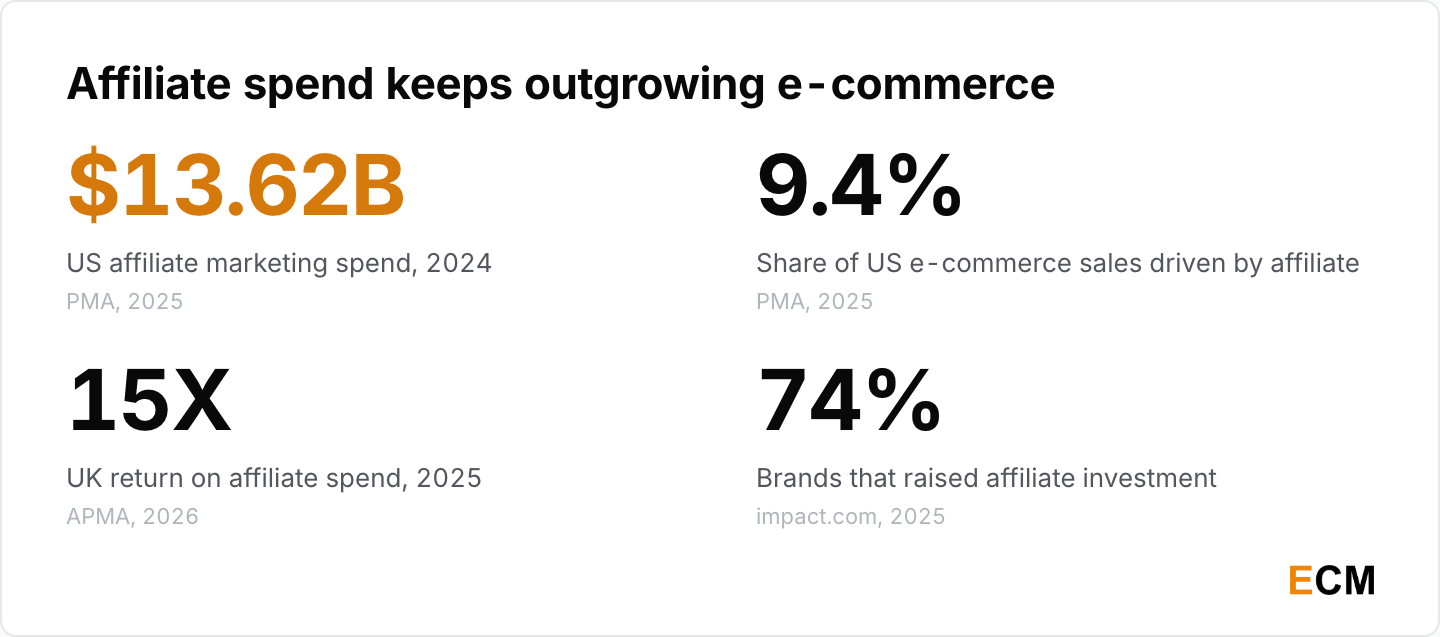
- The US channel is growing faster than e-commerce. US affiliate spend rose from $9.1 billion in 2021 to $13.62 billion in 2024, a 14.42% compound annual growth rate (PMA, 2025).
- Affiliate drives about one in ten US online sales. Affiliate links generated $113 billion in US e-commerce sales in 2024, or 9.4% of the total (PMA, 2025).
- The return is hard to match. UK brands spent £1.8 billion on affiliate in 2025, and APMA puts the return at 15X (APMA, via InPublishing, 2026).
- Brands are moving budget in. 74% of brands raised affiliate investment in the past year because other channels got more expensive (impact.com, 2025).
- Most surveyed affiliates earn very little. In Influencer Marketing Hub’s affiliate survey, 57.55% of respondents made under $10,000 a year and 3.78% cleared $150,000 (Influencer Marketing Hub, 2024).
- AI search is the new worry. 69% of US publishers surveyed are concerned that Google algorithm changes and AI Overviews are reducing their traffic and affiliate revenue (PMA, 2025).
Affiliate Marketing Industry Statistics: Market Size and Growth
Global affiliate spend grew more than 80% between 2017 and 2024 on Influencer Marketing Hub’s estimates, and US spend alone now tops $13 billion.
How Big Is the Affiliate Marketing Industry?
Influencer Marketing Hub projected global affiliate spend at $15.7 billion for 2024, more than five times the 2013 figure.
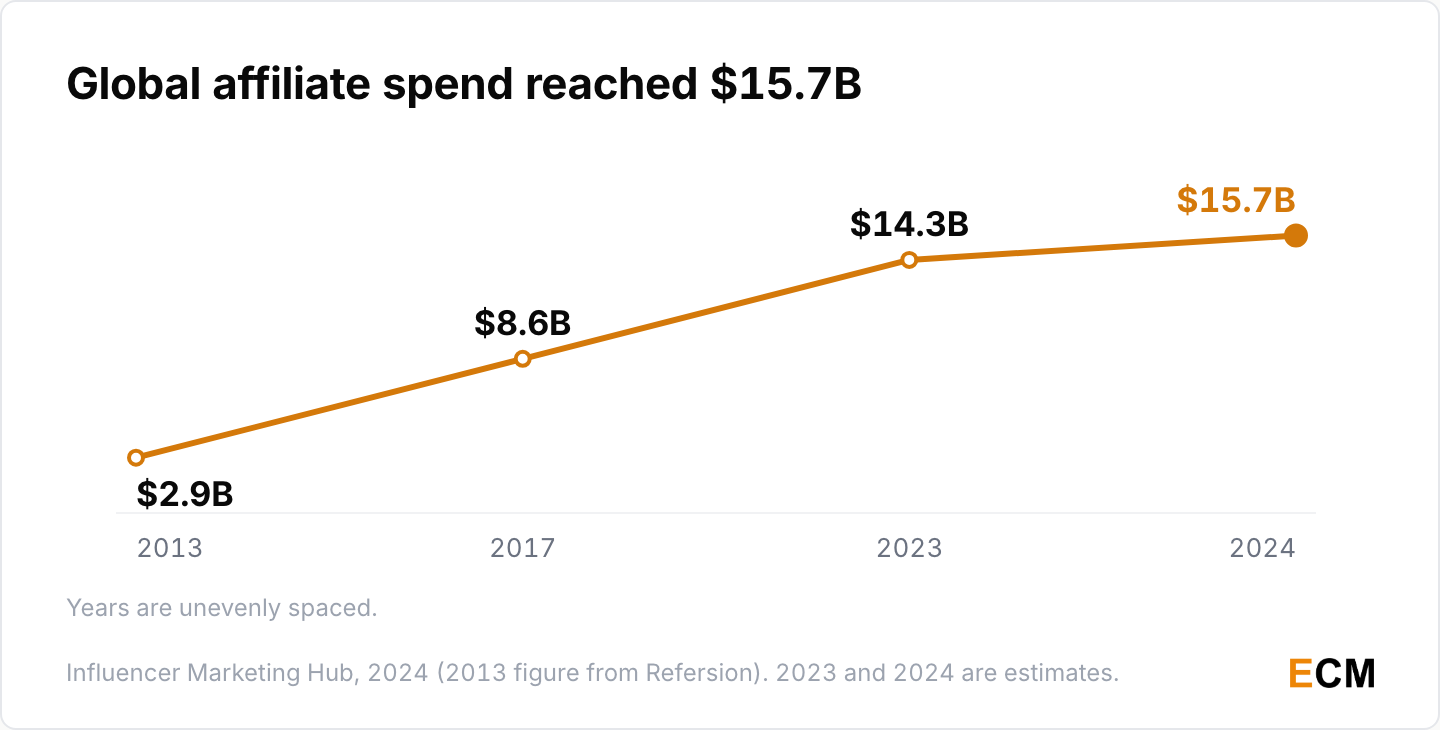
- Influencer Marketing Hub puts global affiliate spend at $8.6 billion in 2017, against Refersion’s $2.9 billion for 2013, and projects $14.3 billion in 2023 and $15.7 billion in 2024 (Influencer Marketing Hub, State of Affiliate Marketing, 2024).
- When this page was published in 2022, Influencer Marketing Hub’s projection put the industry at around $13 billion for 2022 and $15.7 billion by 2024 (Influencer Marketing Hub, 2022). That same year, a market-research press release forecast the affiliate marketing platform software market growing from $14.2 billion in 2021 to about $33 billion by 2027 (Digital Journal, 2022).
US Affiliate Marketing Spend and Sales
PMA says US affiliate spend grew twice as fast as US e-commerce between 2021 and 2024, which is why I’d treat it as a core channel now.
- US affiliate marketing spend rose 49.8%, from $9.1 billion in 2021 to $13.62 billion in 2024, a 14.42% CAGR and twice the pace of broader e-commerce (PMA, Industry Study 2025, 2025).
- That spend generated $113 billion in US e-commerce sales, 9.4% of all US online sales, and an estimated 15% to 20% of sales for companies that run affiliate programs (PMA, 2025).
- Statista projected US affiliate marketing spend would reach $8.2 billion by 2022, up from $5.4 billion in 2017 (Statista, 2022). PMA’s newer study, which uses a different method, puts 2024 at $13.62 billion (PMA, 2025).
What Is the Average ROI of Affiliate Marketing?
Travel leads in both markets, at $19 per $1 in the US and 19X for UK travel and retail.
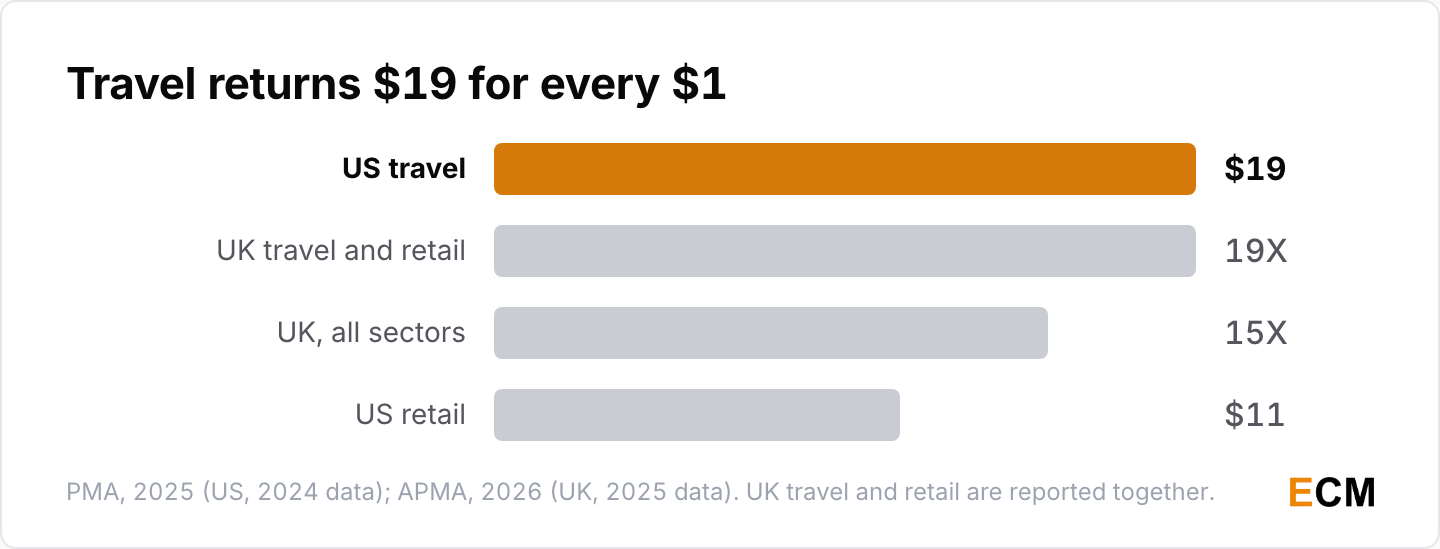
- UK brands invested £1.8 billion in affiliate and partner marketing in 2025, up 7.3%, and generated £20.7 billion in revenue; APMA separately reports a 15X return, rising to 19X in travel and retail (APMA, State of the Affiliate Nation, via InPublishing, 2026).
- A year earlier, UK affiliate spend was £1.7 billion, up 9%, returning £16 for every £1 invested across 360 million sales (APMA, via Adtraction, 2025).
- In the US, travel brands earned $19 for every $1 of affiliate spend in 2024 and retail brands earned $11 (PMA, 2025).
- On UK Cyber Weekend 2025, £1 in every £7 spent online went through an affiliate link, up from 1 in 8 the year before (APMA, via InPublishing, 2026).
Where US Affiliate Spend Goes by Industry
Retail still takes most US affiliate budgets, but finance, travel and telecom grew their share fastest.
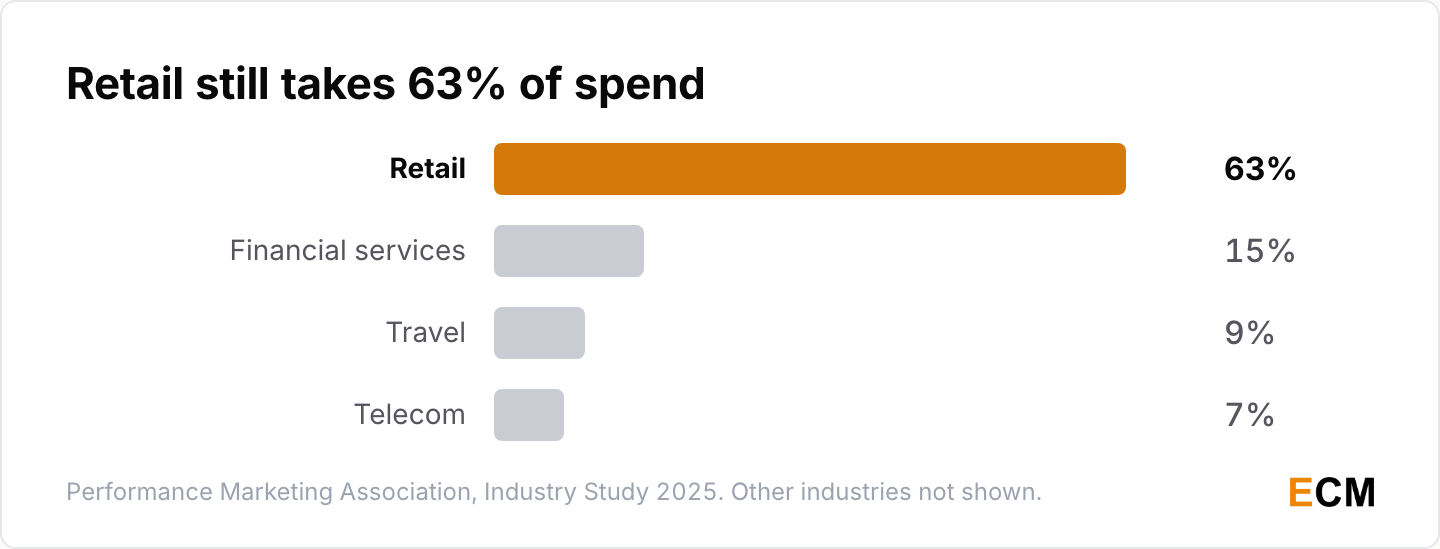
- Retail’s share of US affiliate spend fell from 76% in 2021 to 63% in 2024 (PMA, 2025).
- Financial services rose from 12% to 15%, travel from 5% to 9% and telecom from 3% to 7% over the same period (PMA, 2025).
Affiliate Marketing Growth Statistics: Companies, Networks and Funding
The number of affiliate businesses, the money behind them and public interest all climbed sharply after 2020.
Affiliate Marketing Companies by Region
North America is home to nearly half of the world’s affiliate companies.
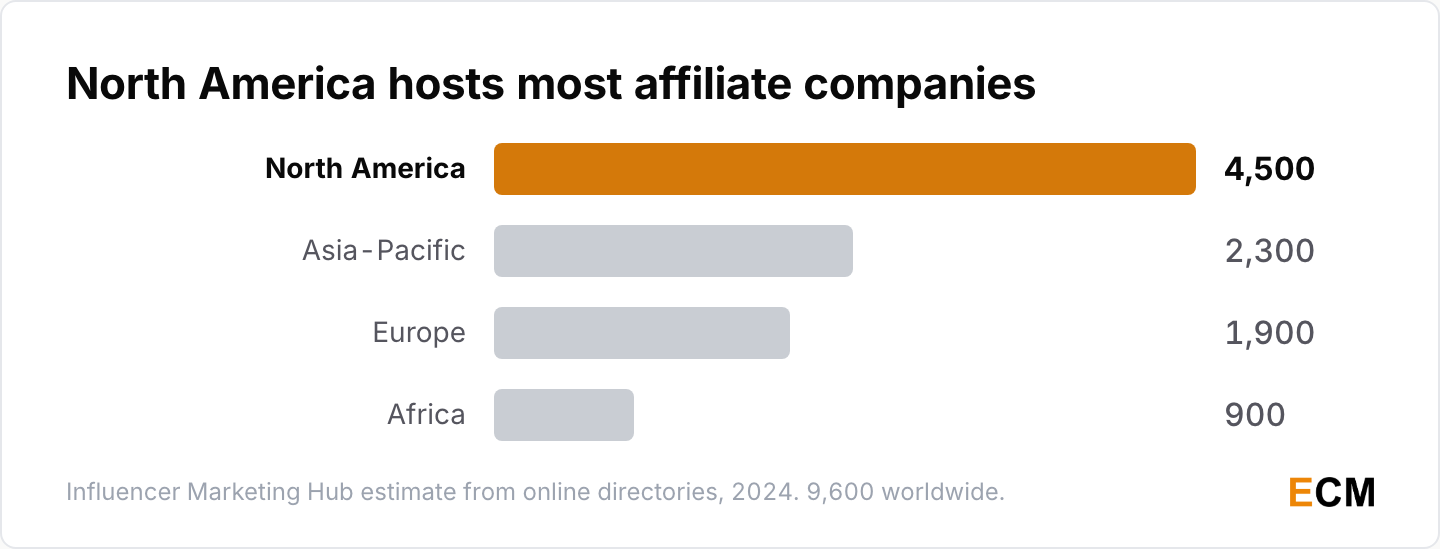
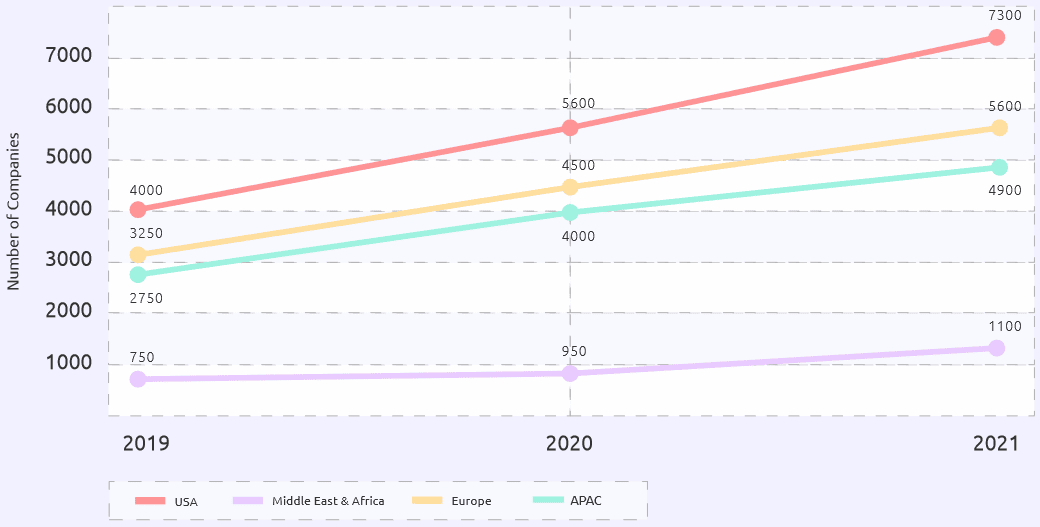
- Influencer Marketing Hub estimates, from online directories, that there were 9,600 affiliate-related services and companies worldwide in 2023: about 4,500 in North America, 2,300 in Asia-Pacific, 1,900 in Europe and 900 in Africa (Influencer Marketing Hub, 2024).
- Affiliate marketing companies had raised $1.5 billion all-time across 232 funding rounds as of 2023, including $303.4 million in 2021 (Influencer Marketing Hub, 2024). The separate $800 million-plus raised in 2021 went to influencer marketing software platforms, not affiliate (Influencer Marketing Hub, Benchmark Report 2022, 2022).
- PartnerStack’s GMV grew 52% in 2025, its network passed $2.7 billion in all-time GMV, and commissions earned by partners rose 54% (PartnerStack, 2026).
Affiliate Marketing Growth During the Pandemic
COVID-19 pushed shoppers toward affiliate content, and the spending gains stuck.
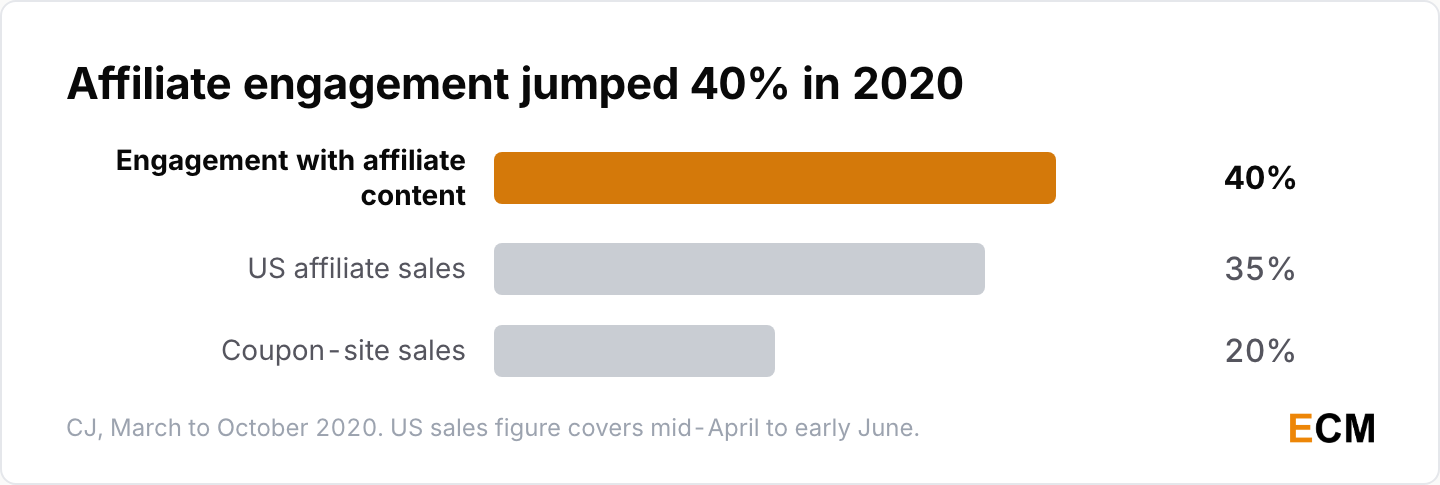
- In CJ’s 2020 look-back, engagement with affiliate content and social publishers rose 40% year over year from March to early April, and coupon-site sales rose 20% from mid-April to early June (CJ, 2020).
- Affiliate sales on CJ’s network for mid-April to early June 2020 rose 35% year over year (CJ, 2020).
- Over 50% of the 185 UK advertisers and agencies IAB UK surveyed saw affiliate spend rise across 2020, a third spent over £50,000 a month on the channel, and 56% recorded higher affiliate revenue since lockdown began in late March 2020 (IAB UK, Affiliates and Partnerships Buyers Survey, 2021).
Search Interest in Affiliate Marketing
People search for affiliate marketing far more than they did before 2020.
- On Ahrefs data, searches for affiliate marketing rose more than 264% between January 2020 and July 2022, peaking at 178,996 monthly searches (Influencer Marketing Hub, 2024).
- A November 2022 Google Trends reading for 2016 to 2022 showed search interest in affiliate marketing up about 400% from January 2016 to its August 2022 peak (Google Trends, 2022). Influencer Marketing Hub reads Google Trends as interest doubling between 2017 and 2020 (Influencer Marketing Hub, 2024).
Brand Affiliate Marketing Statistics: Budgets, Revenue and Commissions
Brands are spending more on affiliate because paid media keeps getting pricier, and commission rates vary by category.
How Much Brands Invest in Affiliate Programs
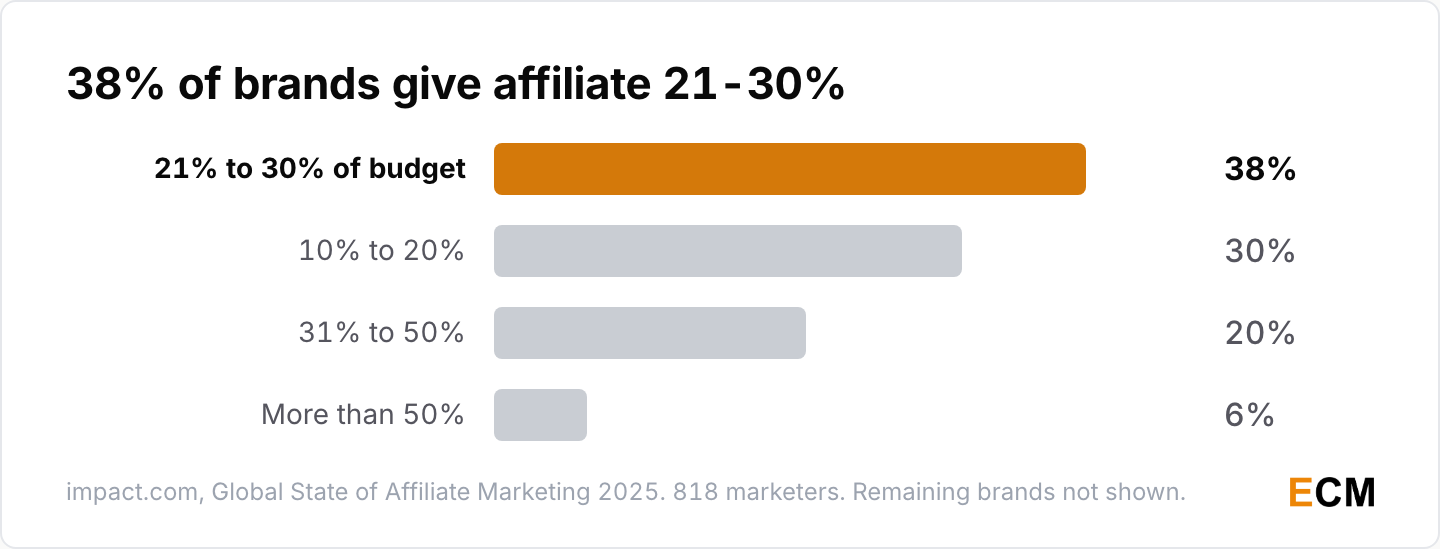
Most brands now put more than a fifth of their marketing budget into affiliate.
- 74% of brands increased affiliate investment in the past year because other marketing channels became more expensive (impact.com, Global State of Affiliate Marketing 2025, 2025).
- 38% of brands put 21% to 30% of their marketing budget into affiliate, 30% put 10% to 20%, 20% put 31% to 50% and 6% put more than half (impact.com, 2025).
- 74% of brands generate 11% to 30% of their total revenue from affiliate marketing, and 59% plan to spend at least 25% of their affiliate budget on creators (impact.com, 2025).
Affiliate Programs and Customer Acquisition
75% of senior US marketers rated affiliate successful or better at winning customers in Forrester’s 2019 study.
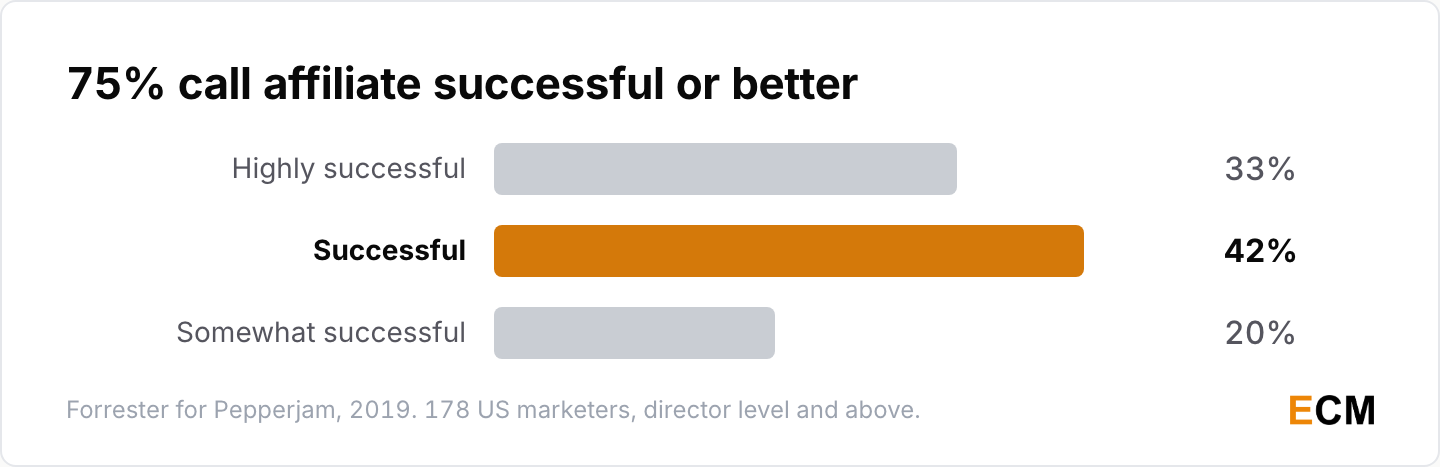
- Of 178 US marketers at director level and above, 33% called their affiliate programs highly successful at customer acquisition, 42% successful and 20% somewhat successful, so 75% rated it successful or better and 95% reported some success (Forrester for Pepperjam, 2019).
- In Awin and Forrester’s survey of senior marketers, fielded at the end of 2024, 52% named personalizing marketing communications and 50% named improving customer experiences as top-five goals affiliates could support (Awin and Forrester, 2025).
Affiliate Commission Rates and Payment Models
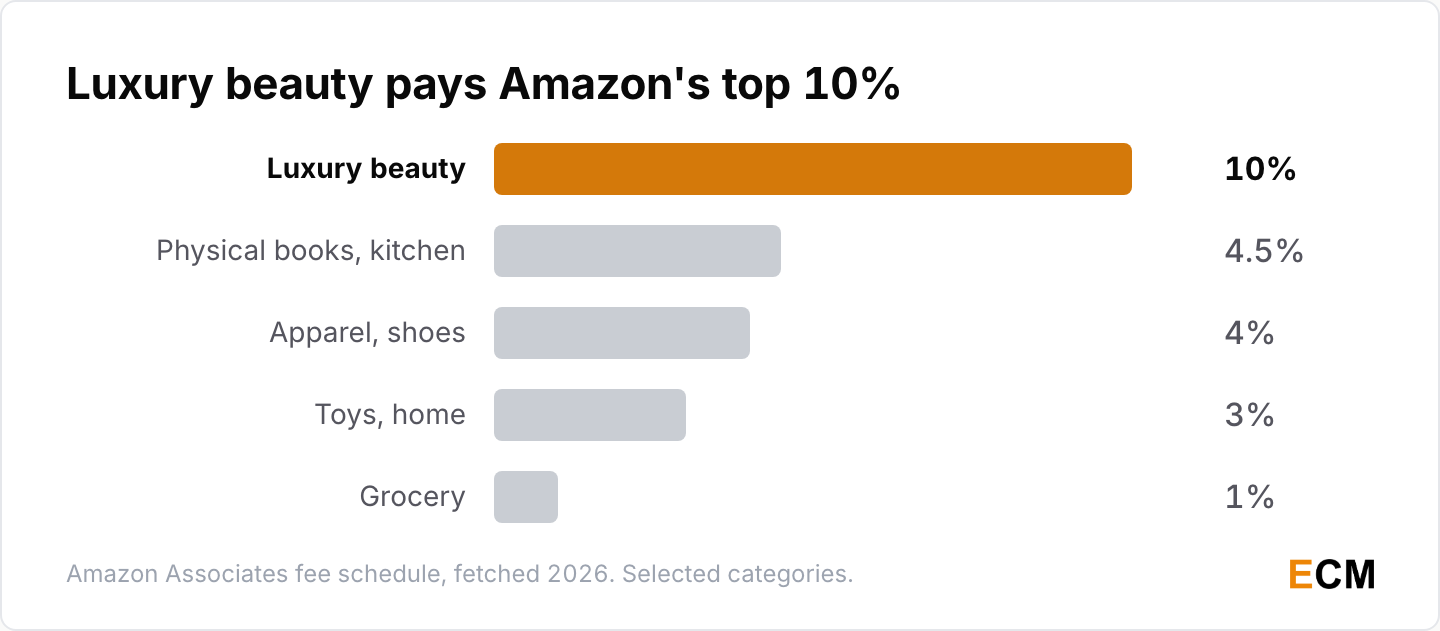
Amazon pays 1% to 10% on physical products, while software and finance programs pay several times more.
- 48.9% of brands pay affiliates a flat rate and 42.4% pay a percentage of sales (Influencer Marketing Hub, 2024).
- SaaS programs pay 20% to 70% commission, and finance programs mostly pay 35% to 40% (Influencer Marketing Hub, 2024).
- Amazon Associates pays 10% on luxury beauty, 4.5% on physical books and kitchen, 4% on apparel and shoes, 3% on toys and home, and 1% on grocery (Amazon Associates, 2026).
- Across PartnerStack’s 25 highest-performing vendors, the commission rates behind the most total payouts in 2025 were 20%, 25% and 30%, in that order (PartnerStack, 2026), against a 23.53% average commission among its top vendors in 2023 (PartnerStack, 2024).
Can I Use ChatGPT for Affiliate Marketing?
Yes. AI use is close to universal among surveyed brands and creators, and brands now pay for content that AI answers will cite.
- 97% of brands and 96% of creators use AI in their partnership programs, and 94% of brands are testing or planning alternative attribution models within a year (impact.com, 2025).
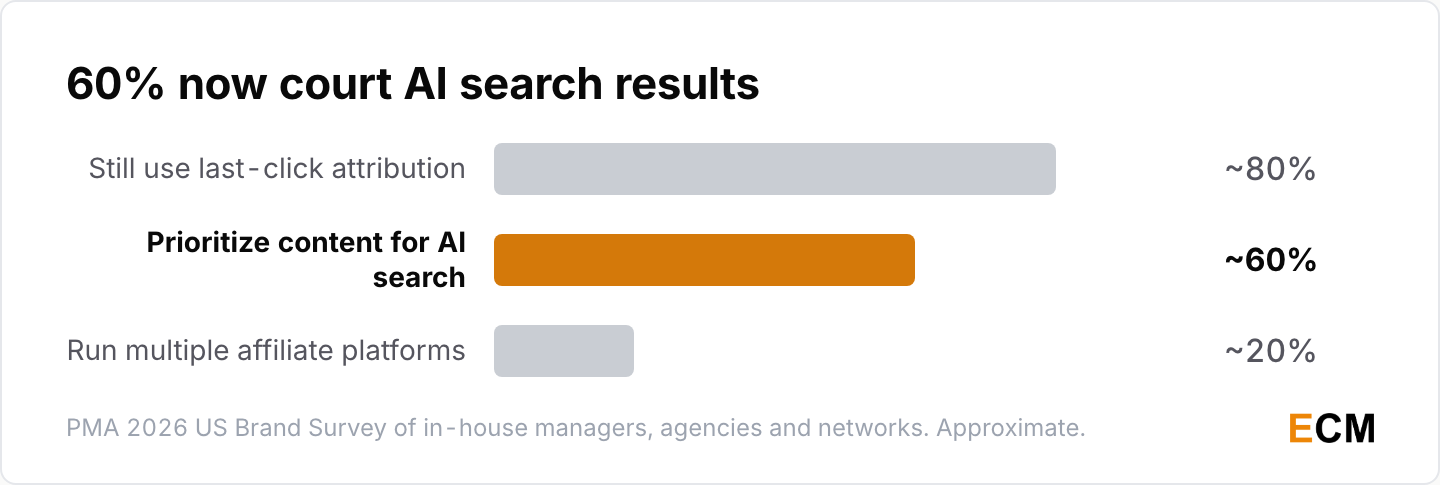
- Around 60% of respondents to the PMA’s 2026 US brand survey of in-house managers, agencies and networks deliberately prioritize content partnerships built to influence AI search results and LLMs, almost 80% still use last-click attribution, and the share of businesses running multiple affiliate platforms jumped from just under 9% to nearly 20% (PMA, 2026 US Brand Survey, 2026).
- Across six US consumer categories, Partnerize puts publishers’ influence at 3.84 times what click tracking records, from 1.54x in consumer audio to 10.94x in luxury fashion (Partnerize, Zero-Click Economy report, 2026).
Affiliate Publisher Statistics: Partner Types, Traffic and Challenges
Creator and email partners are gaining ground, mobile keeps growing, and AI search worries most publishers.
Which Affiliate Partner Types Bring New Customers
Among named partner types, buy-now-pay-later and creator partners get the highest share of revenue from new customers; loyalty sites get the lowest.
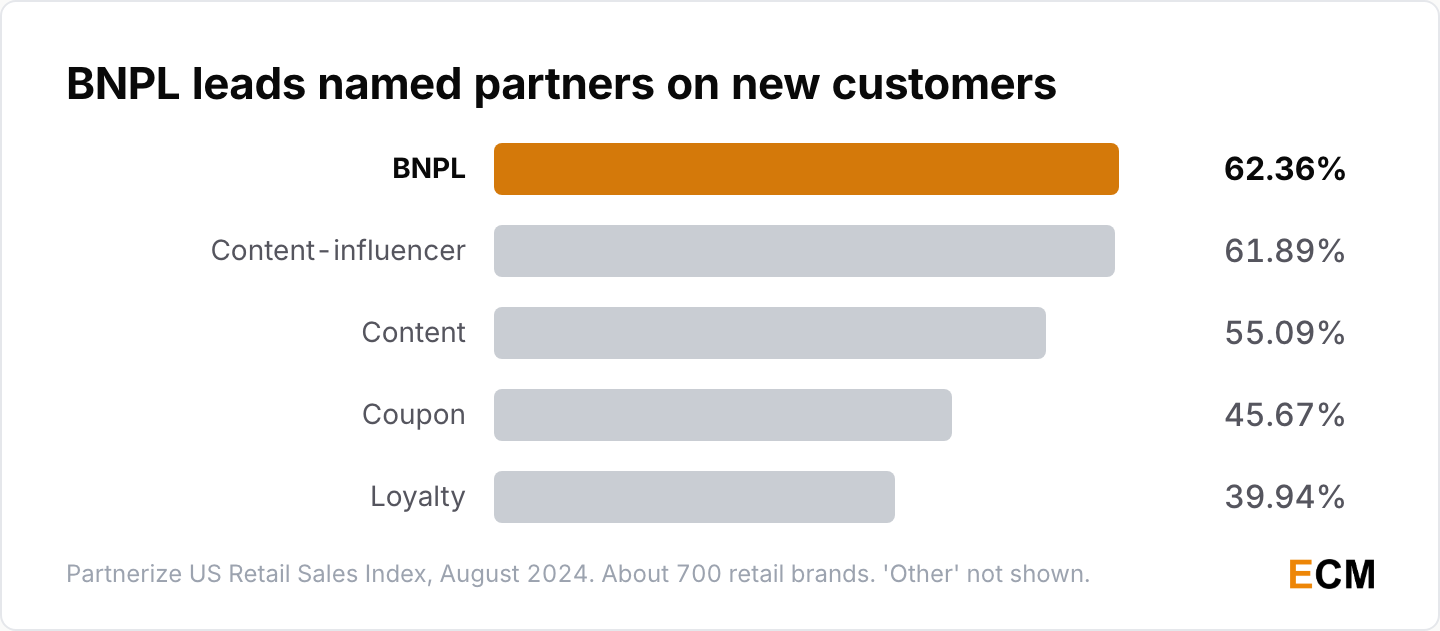
- New customers made up 62.36% of revenue from BNPL partners, 61.89% from content-influencer partners, 55.09% from content, 45.67% from coupon and 39.94% from loyalty partners across about 700 US retail brands in August 2024 (Partnerize, US Retail Sales Index, 2024).
- Content partners earned 43% of commission on Partnerize in August 2024, down 12% year over year (Partnerize, 2024).
- In Awin and Forrester’s end-2024 survey, 59% of marketers had email and newsletter partners in their program, up 19% on 2023, and 54% had brand partnerships; Awin’s own brand-partnership sales rose 93% year over year (Awin and Forrester, 2025).
- Awin’s 2020 report said content and PPC publishers dominated the UK’s early affiliate market, and the rise of coupon and cashback partners then reshaped the sales split (Awin Report 2020, 2020).
Influencers and Mobile Traffic in Affiliate Programs
Social creators went from a sliver of new affiliate sign-ups to most of them in under two years.
- On Partnerize’s chart of approved publisher sign-ups, social media publishers went from a few percent in November 2020 to more than 80% by August 2022 (Partnerize, Sales Index August 2022, 2022).
- Mobile accounted for 37.5% of affiliate conversion activity in August 2022 (Partnerize, 2022) and 42% of revenue by August 2024 (Partnerize, 2024).
Affiliate Marketing Challenges and Risks
Publishers are confident about the channel but worried about Google, fraud and slow payments.
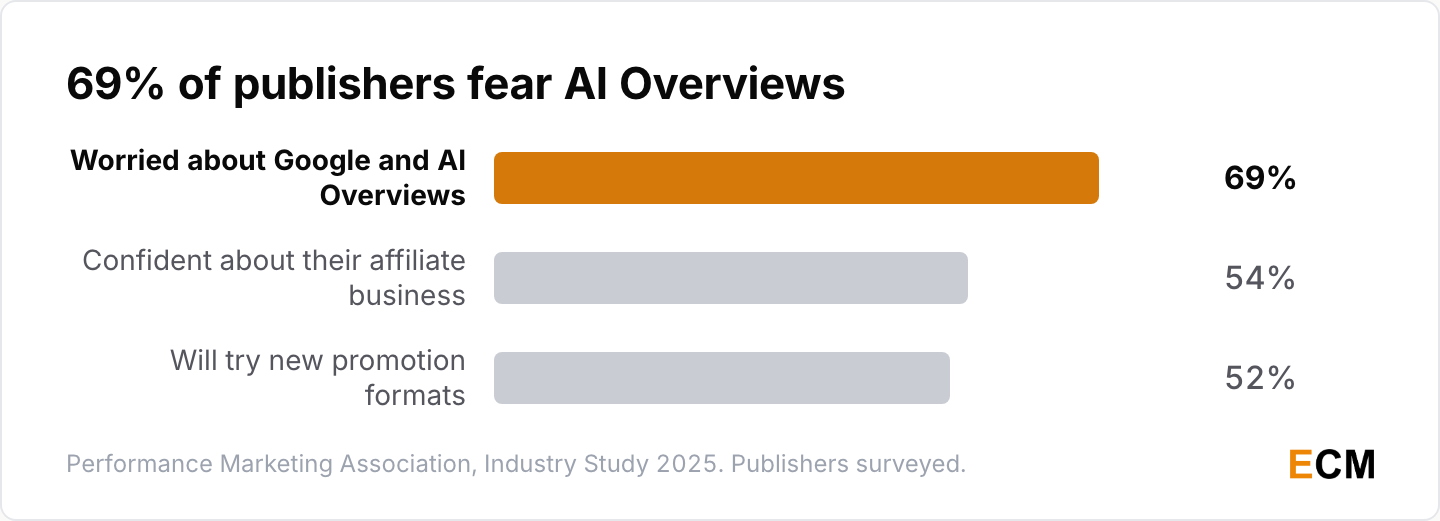
- 69% of surveyed US publishers are concerned about Google algorithm changes and AI Overviews reducing traffic, 54% are confident about their affiliate business and 52% will try new promotion formats (PMA, 2025).
- 80% of UK publishers expect growth in 2026, but 47.3% report a moderate or significant operational impact from slow commission payments (APMA Voice of the Nation, via hellopartner, 2025).
- One affiliate consultant told a UK publishing-industry event that AI Overviews cut traffic to review content by up to 50%, with affiliate revenue down 20% to 40% at some publishers (Press Gazette, 2025).
- Anura, a fraud-detection vendor, says roughly 45% of affiliate traffic was flagged as invalid or fraudulent in 2024 (Anura, 2024).
How Much Do Affiliate Marketers Make? Earnings and Demographics
Affiliate income is heavily skewed, with a small group earning six figures while most affiliates earn side-income money.
Affiliate Marketer Income Brackets
More than half of surveyed affiliates earn under $10,000 a year from the channel.
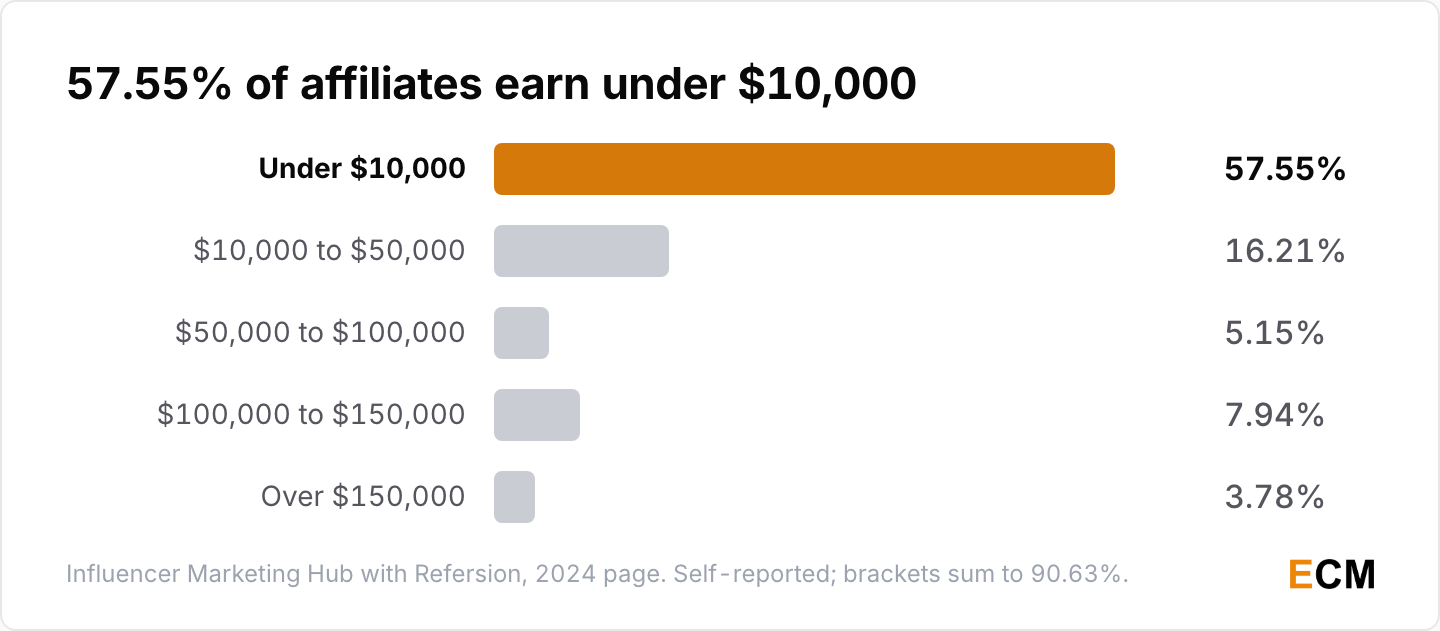
- 57.55% of surveyed affiliates earn under $10,000 a year, 16.21% earn $10,000 to $50,000, 5.15% earn $50,000 to $100,000, 7.94% earn $100,000 to $150,000 and 3.78% earn more than $150,000 (Influencer Marketing Hub, 2024).
- When this page first ran in 2022, it quoted Statista’s chart of a 2021 worldwide affiliate survey as showing more than 55% earning under $10,000, about 16% up to $50,000 and about 4% over $150,000 (Statista, 2022).
- In Authority Hacker’s survey of 2,270 affiliates, the average earns $8,038 a month; respondents with three-plus years of experience report 9.45 times the income of beginners, and 45.3% call traffic their biggest challenge (Authority Hacker, 2024).
How Many Affiliate Marketers Are There?
No one counts every affiliate, but the largest networks list from 900,000 affiliates to more than 2 million partnerships.
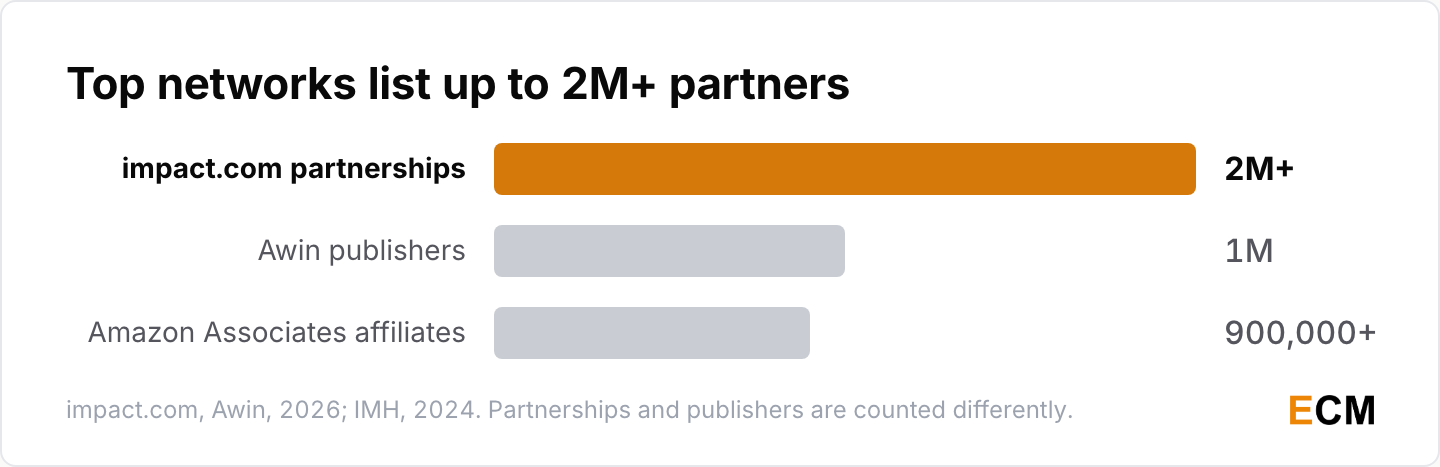
- Awin lists 1 million publishers and 30,000 advertisers, and says it generated £18 billion for advertisers and £1.2 billion for publishers in its last financial year (Awin, 2026).
- Amazon Associates is the largest affiliate network, with more than 20% of listed affiliate programs and over 900,000 affiliates (Influencer Marketing Hub, 2024).
- impact.com powers more than 2 million partnerships generating over $110 billion in annual GMV (impact.com, 2026).
Affiliate Marketing Manager Demographics
The people running affiliate programs skew male and over 30.
- 57.5% of US affiliate marketing managers are men and 42.5% are women, and women earn $80,802 on average against $84,546 for men, or 96 cents on the dollar (Zippia, 2025).
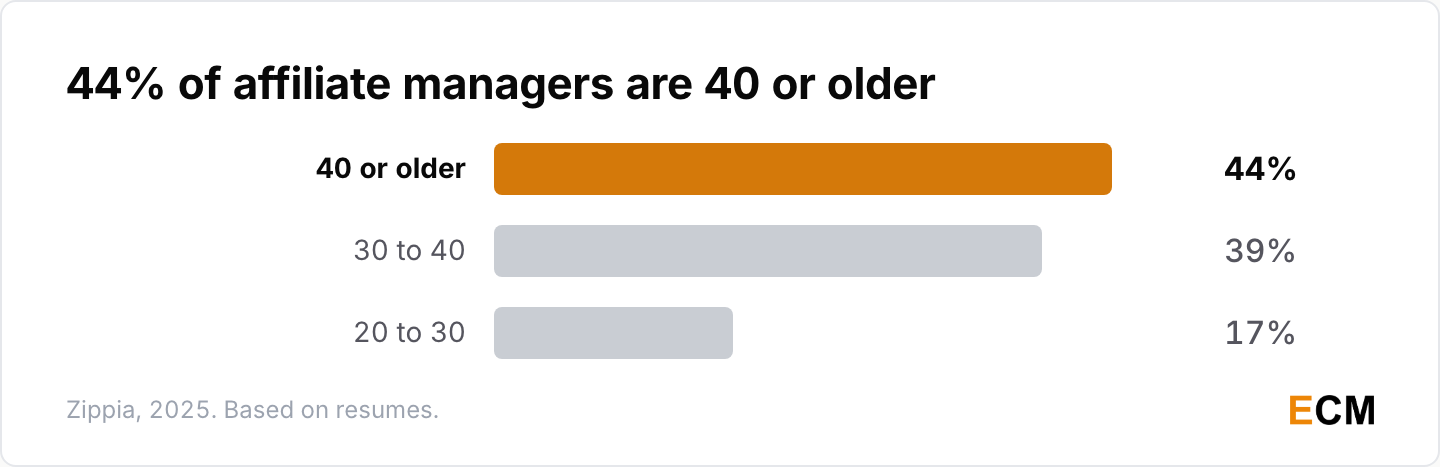
- 44% of affiliate marketing managers are 40 or older, 39% are 30 to 40 and 17% are 20 to 30, with an average age of 39.3 (Zippia, 2025).
Influencer and Creator Affiliate Marketing Statistics
Creators are the fastest-growing partner type, and affiliate links are one of the main ways they get paid.
Influencer Marketing Market Size
Influencer Marketing Hub estimates influencer marketing at $32.55 billion in 2025, about double its $15.7 billion estimate for affiliate in 2024.
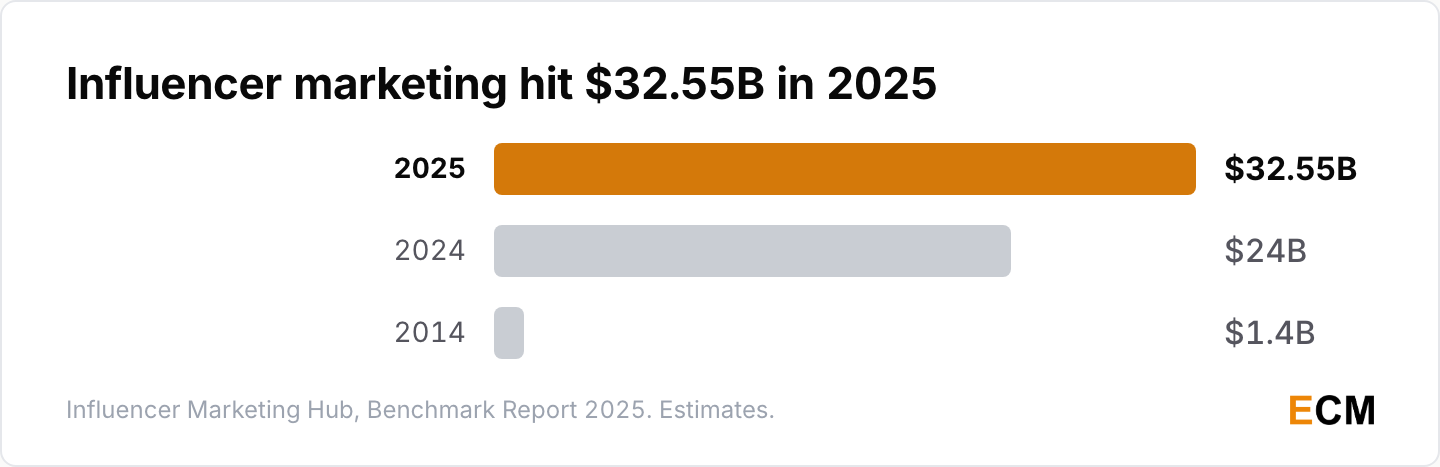
- Influencer Marketing Hub estimated the influencer marketing market at $32.55 billion for 2025, up from $24 billion in 2024 and $1.4 billion in 2014 (Influencer Marketing Hub, Benchmark Report 2025, 2025). Back in 2022, more than 75% of brand marketers planned to dedicate budget to influencer marketing (Influencer Marketing Hub, Benchmark Report 2022, 2022).
- US influencer marketing spending was forecast to hit an all-time high of $7.1 billion in 2024 (Statista, 2025), and eMarketer expects $10.52 billion in 2025 (eMarketer, 2025). When this page was first published in 2022, it quoted eMarketer projecting $7.14 billion for 2024 and 74.5% of US marketers at companies with 100+ employees using influencer marketing (eMarketer, 2022), plus HypeAuditor’s forecast of $22.2 billion for the global influencer market by 2025, with sponsored YouTube videos costing from $60 to thousands of dollars (HypeAuditor, State of Influencer Marketing 2022, 2022).
Platforms Brands Use for Creator Campaigns
Instagram and TikTok lead creator campaigns, and TikTok Shop dominates social commerce.
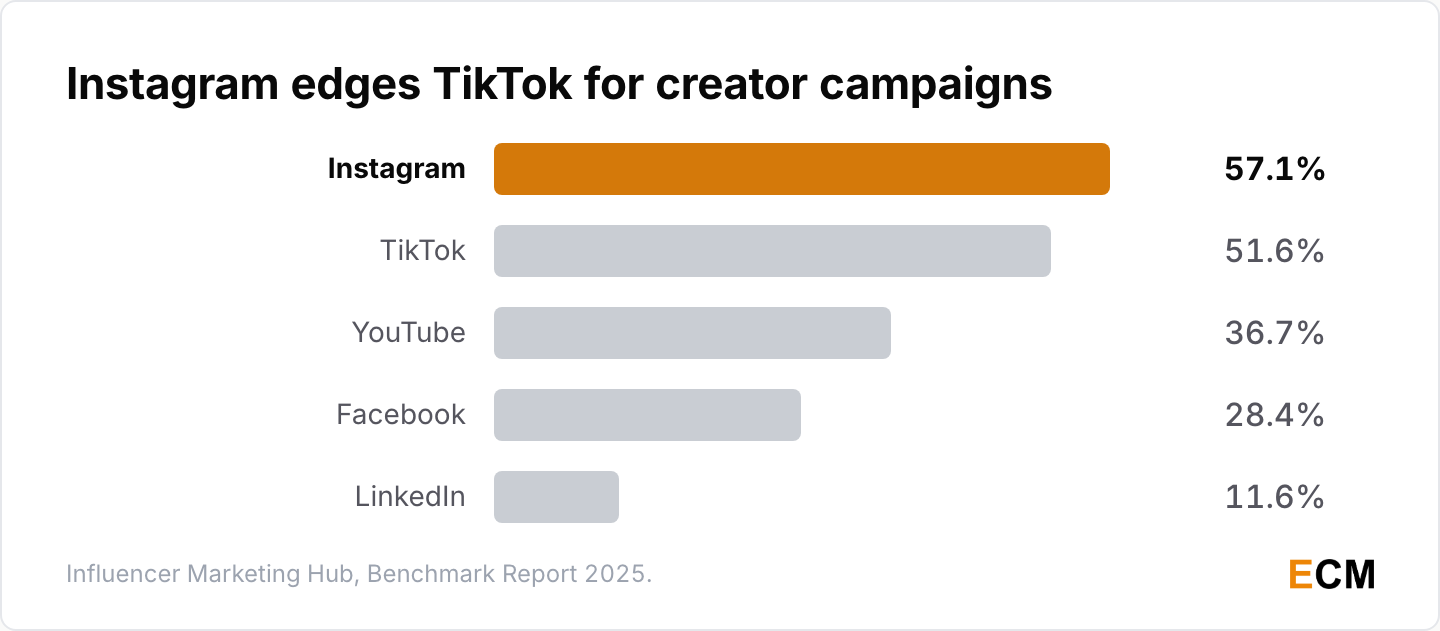
- Instagram is the preferred influencer channel for 57.1% of marketers, ahead of TikTok at 51.6%, YouTube at 36.7%, Facebook at 28.4% and LinkedIn at 11.6% (Influencer Marketing Hub, Benchmark Report 2025, 2025).
- Among brands selling through social commerce, TikTok Shop takes 66.17% of platform selections, Instagram Checkout 13.16% and YouTube Shopping 9.02% (Influencer Marketing Hub, Benchmark Report 2026, 2026).
- 45.9% of brands track creator sales with promo or discount codes, 26.0% with affiliate links and 25.0% with native shop features (Influencer Marketing Hub, 2026).
- In 2022, almost 80% of brands doing influencer marketing used Instagram (Influencer Marketing Hub, Benchmark Report 2022, 2022), and GRIN reported that about 80% of 230.5 million US digital shoppers, roughly 184 million people, bought after seeing an influencer recommend a product (GRIN, 2022). The same 2022 version of this page quoted GRIN on 70% of online shoppers using Instagram for product discovery and 44% shopping on it weekly (GRIN, 2022), and Influencer.in on 98% of creators preferring Instagram and 37% of brands preferring to partner there (Influencer.in, 2022).
Nano Creators Get the Highest Engagement
Smaller creators get far more engagement per follower, which suits commission-based deals.
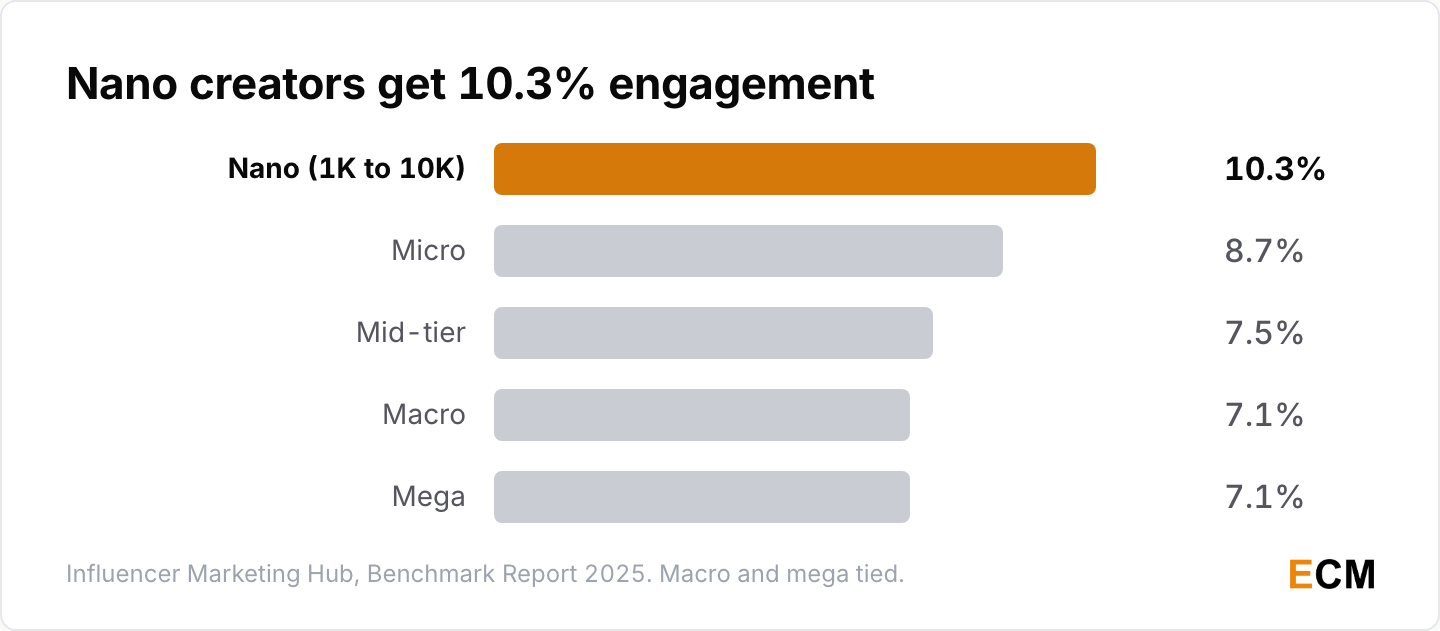
- On TikTok, nano creators (1,000 to 10,000 followers) averaged 10.3% engagement in 2024, against 8.7% for micro, 7.5% for mid-tier and 7.1% for macro and mega creators (Influencer Marketing Hub, Benchmark Report 2025, 2025).
- Instagram nano creators averaged 1.73% engagement, and nano accounts make up 75.9% of Instagram’s influencer base and 87.68% of TikTok’s (Influencer Marketing Hub, 2025).
Creator Income and Affiliate Links
Affiliate links are the top income driver for many creators, but most creators still earn modest amounts.
- 70% of 1,562 Linktree creators surveyed earn less than $49,000 from content, and they named affiliate revenue as their top income driver (Linktree, Creator Commerce Report 2024, 2024).
- Over 48% of the 2,000 creators Influencer Marketing Hub surveyed earn $15,000 or less a year, and over 66% earn most of their revenue from brand deals (Influencer Marketing Hub, Creator Earnings Benchmark, 2023). In its 2025 report, more than half earn under $15,000 and over 49% earn most of their revenue from brand deals (Influencer Marketing Hub, Creator Earnings Report 2025, 2025).
- Goldman Sachs expects the creator economy to grow from $250 billion to $480 billion by 2027, with about 4% of 50 million creators earning over $100,000 a year (Goldman Sachs Research, 2023).
For more on creators, see my influencer marketing statistics, creator economy statistics, content marketing statistics and email marketing stats.
Frequently Asked Questions
How big is the affiliate marketing industry?
Influencer Marketing Hub projected global affiliate spend at $15.7 billion for 2024 (Influencer Marketing Hub, 2024). That looks low, since the US alone spent $13.62 billion that year (PMA, 2025), and the UK spent £1.8 billion in 2025 (APMA, 2026).
How much do affiliate marketers make?
Most make little: in Influencer Marketing Hub’s survey, 57.55% earn under $10,000 a year and 3.78% earn over $150,000 (Influencer Marketing Hub, 2024). Authority Hacker’s survey puts the average at $8,038 a month (Authority Hacker, 2024).
What is the average ROI of affiliate marketing?
On APMA’s own ROI measure, UK brands earned a 15X return in 2025, rising to 19X in travel and retail (APMA, 2026). In the US, travel returned $19 per $1 and retail $11 in 2024 (PMA, 2025).
What is the 80/20 rule in affiliate marketing?
It’s a rule of thumb that a small share of affiliates earns most of the money. The income survey points the same way without measuring an exact 80/20 split: 11.72% of respondents earn over $100,000 a year while 57.55% earn under $10,000 (Influencer Marketing Hub, 2024).
Do I need an LLC to be an affiliate marketer?
No. Amazon Associates and the big networks accept individuals, and you report commissions as self-employment income. For tax years beginning after 2025, payers generally file Form 1099-NEC for nonemployee pay, which can include commissions, of $2,000 or more (IRS, 1099 instructions, 2026). An LLC is a liability and tax decision for later; ask an accountant once commissions become real money.
Can I use ChatGPT for affiliate marketing?
Yes. 97% of brands and 96% of creators already use AI in partnership programs (impact.com, 2025). I’d use it for research and drafts, then add your own testing, because around 60% of respondents to PMA’s 2026 US brand survey prioritize content partnerships aimed at AI search results (PMA, 2026).
Is affiliate marketing worth trying in 2026?
For brands, yes: in impact.com’s survey of 818 marketers across eight countries, 74% of brands raised affiliate investment last year (impact.com, 2025). For publishers, it’s worth it if you can wait: 80% of UK publishers expect growth in 2026 (APMA, 2025), and respondents with three-plus years of experience report 9.45 times the income of beginners (Authority Hacker, 2024).
What percentage of online sales comes from affiliate marketing?
Affiliate drove 9.4% of all US e-commerce sales in 2024, about $113 billion, and an estimated 15% to 20% of sales at companies that run affiliate programs (PMA, 2025).
Written by
Editorial Staff
The Editorial Staff represents the writers, editors, and content creators who have worked (or work) at Elite Content Marketer. The experimenter-in-chief behind the team is Chintan Zalani, who has close to a decade of experience trying to make sense of the content marketing industry. Started in 2019, Elite Content Marketer is on a mission to help creators build sustainable businesses.
Related Articles

Marketing Data
Career Change Statistics 2026: 59 Facts That Matter
59 career change statistics for 2026: how often people switch careers, why they do it, the average age, what it pays and what stops them.
Nov 9, 2026Read more →

Marketing Data
EdTech Market Statistics 2026: 60 Funding and AI Facts
60 edtech market statistics for 2026: market size, venture funding, Duolingo and Coursera results, school device use, AI adoption and cybersecurity data.
Nov 3, 2026Read more →
Marketing Data
Branding Statistics 2026: 60 Facts You Need to Know
60 branding statistics for 2026: brand value rankings, trust and authenticity, user-generated content, social media, loyalty and B2B branding data.
Nov 2, 2026Read more →